Is Human Space Flight more like the airline industry or the automobile industry?
In a recent post at Space News, guest-blogger Gordon Smith, Ph.D., acknowledges the reality that Human Space Flight has not been truly commercialized while other highly complicated and risky industries have flourished privately. Smith believes those attempting to commercialize human spaceflight utilizing an airline industry business model could be more successful by changing models.
Might the automobile industry provide a better business model for Human Space Flight to be patterned after? Cars and trucks are specialized for the needs of their users and onboard redundancies are minimized through the use of AAA, tow trucks, gas stations, and other readily available "emergency services" that are easily accessible to motorists on the road. Smith argues in favor of:
Rescue craft capable of reaching both space stations and free-flying spacecraft on short notice (perhaps already on-orbit)
Maintenance craft (think spare parts)
Rendezvous craft (think tugs)
and of course depots
NASA could provide the rescue service or perhaps such a rescue service could be offered as a private venture:
Added redundancy for NASA
Like COTS, another way for NASA to stimulate the industry
Lower Insurance premiums for Bigelow
Lower Insurance premiums for all private manned launches
Note: for these to be a help to humans in space, these vehicles do not necessarily need to be manned themselves. This quote from his blog post sums up Smith’s position:
“The automotive industry operates similarly to human spaceflight, if one looks at the broad operational behaviors. A vehicle departs from a certain location, travels for a period of time that may be limited or indefinite (but the car may pause as needed), and can return to any number of locations. However, the automotive industry prevents DTD and redundancy costs from growing prohibitive using government or private means to render assistance in the form of ambulances and tow trucks.
We gain so much by adjusting the human spaceflight industry model to better support their operations. Creating a means by which aid may quickly be dispatched to space stations or vehicles on orbit is within the scope of the 2010 National Space Policy, reduces the costs associated with human spaceflight and makes it easier for private commercialization to grow. Instead of having to counter every possibility, known and unanticipated, private vehicles and stations need only ensure that if something goes wrong, their occupants will be able to safely wait for help. This is an improved response over escape pods currently under consideration, as it does not leave an abandoned asset worth billions of dollars to drift unattended in orbit, where it may easily be lost.”
Gordon Smith has also written this paper on the macro-economic impacts on the space industry where he strikes similar tones. This paper warrants closer scrutiny. Perhaps in an upcoming post. For now, I like this quote from the paper:
"This emergency response capability, then, should be made a priority in forthcoming policy so that the long promised commercial sector may finally develop."
Are you a NewSpace organization? Could you use a group of MBA’s at your disposal to complete company projects without the cost of keeping them on your payroll? Meet the NewSpace Business Group. Think of the NewSpace Business Group as a network for nearly minted passionate, space-minded MBA’s that gain valuable business experience by solving real world problems for the NewSpace industry.
So listen up Altius, Armadillo, Bigelow, Masten, XCOR, SFF, and NLV Challenge competitors. The NewSpace Business Group is available to assist with your:
Jonathan Card: The NewSpace Business Group is a student group for business students, historically at the MBA level, interested in space businesses. We are focused on bridging the gap between the space technical community and other specialties in business that are necessary to run a successful company. One of the most destructive things that our current space policy has done is that NASA has frequently had to act as the intermediary between the space companies and the public. NASA's goal has been to foment experimentation and technical advances that were necessary in the 1960s to get humans to space.
Unfortunately, it's not enough for the technology to exist, but it has to exist in a network of social institutions that manufacture it, improve it, and operate it and there has been limited success in forming these kinds of institutions. This is very difficult for the government to do in a democracy, but NASA has recently begun to rectify this. COTS, SBIR, and, I think, Obama's recent NASA budget have started to bridge this gap.
The NewSpace Business Group is a setting for people in the space community to apply what they are learning in school to the industry that needs to learn it and so that business people that specialize in Marketing, in Finance, or in other aspects of private companies can learn from the NewSpace Business Group members on their campus that space is a viable place to do business and make a profit. It's less and less true that there's only one customer (NASA), that you need to get money (from NASA) before you can build anything, that you need to structure your company around government contracting and procedures.
Q: There are many other campus organizations. Why do you think you will be able to attract top business talent?
Jonathan Card: Because space is awesome, of course! It's space! Seriously, though, space is the New World of our time. It's a place that is unsettled and full of riches, from solutions to the energy crisis to new IP that can only be discovered in space. It is what will keep our civilization alive when an asteroid comes to finish us off like the dinosaurs before us, when nuclear weapons finally get out of hand, and when some unknowable tragedy strikes our ecosphere. In the end, money is the way for the people to show what's important to them; since space is important, there must be money to be made and the one to figure it out, gets to keep it. Fortunes were made, lost, and made over and over in the transatlantic trade and in the mines and forests of the New World. It will happen again in space.
Q: How do you see the NewSpace Business Group benefiting the NewSpace industry?
Jonathan Card: I would like to see NewSpace alumni forming the next cadre of managers and entrepreneurs of space-oriented companies. There are a lot of exciting companies coming of age right now and there are still holes to be filled in. Companies are just learning to talk to each other, how to do business with each other, and what institutions other industries created for themselves that space companies don't have because the unrelenting NASA-focus of the past has prevented a mature industry from emerging organically.
There are opportunities here that we haven't yet dreamt, and they are problems that MBAs and other business school students study full-time. We are the leaders that will make this industry make money and will make money elsewhere and bring it to NewSpace and so into the future.
Q: What you like the NewSpace Business Group to grow into over the next few years?
Jonathan Card: I'd like to make it into a national campus organization whose members know each other, work together, and can learn to rely on each other. I'd also like to make it into a group whose name becomes a credential; that, with the NewSpace Business Group on their resume, business school students can be assured of at least an interview with investors, companies, and other firms in the space industry.
Q: How can the New Space Industry benefit from your group’s efforts today? Internships? Projects? Other?
Jonathan Card: We have done projects for NewSpace groups already; we helped organize some of the events at the NewSpace 2009 conference (it was this experience that led to me becoming Treasurer of the Foundation) and we did an industry analysis of the future of the CubeSat industry for a Google Lunar X Prize competitor applying modern industry theories of innovation to see if we can establish some insight into the future growth of that technology. Portions of that paper are being prepared for public distribution; stay tuned to http://www.newspacebusiness.org/ or our LinkedIn group for more information on that, probably in December. We are always looking for projects and internships for our participants. The benefits are subtle and more widespread than you may think.
Last spring, we arranged a campus talk by Dannie Stamp, the former COO of Iridium (you can watch this on our YouTube channel); bringing such a luminary to campus was important to the school and it was my understanding at the end of the year that the school was interested in building stronger ties with him. This kind of relationship can be an important way for NewSpace to be highlighted in publications and to be used as examples in classrooms. That kind of publicity, in the context of other topics, is an important way to mainstream what we're doing.
Q: How can the New Space Industry help you become successful? Where do you need help to take the New Space Business Group to the next level?
Jonathan Card: I don't really want to focus on "how can the NewSpace industry help me". It's important to me that this remains a group that comes together to help the industry. Even when we are looking for projects, it's important that those projects are not just make-work for the sake of a good idea. If we can't help NewSpace, there's no point is being a group. If NewSpace can't help humanity, there's no point in it existing. I firmly believe that for-profit businesses, and those of us that believe in the power of the private sector, exist solely to serve others and be others-centered; usually our customers. I guess the most the NewSpace industry can do for us is to remember that we are there for them, and our members are a group of people that will know something about their industry, and if they need something done or they need good people, we are here to help.
Q: If anyone reading this wants to get involved how can they get a hold of you?
Jonathan Card: jcard@email.arizona.edu will still reach me, even though I've graduated, as will any message through the LinkedIn group. This has been dormant for the last few months, but we're revisiting it and will be re-opening it for new members soon. We welcome industry members, students, prospective students, or anyone else that wants to keep up on our activities.
Q: What should I have asked that I didn’t?
Jonathan Card: What are you doing now?
The NewSpace Business Group has alumni at Sargent Controls, which manufactures parts for military and civil space and airplane parts, and we have several members that have started their own businesses after business school.
I'm working at a cloud software company, B50 Data, making software for tracking maintenance for commercial shipping fleets. We're finishing our first round of sales calls without any venture or angel capital, and we're very optimistic. In addition to polishing the paper on CubeSats for publication, I'm finishing a paper overviewing international property law and various means of resolving complex IP legal situations, like those in cloud computing, other than expanding the power of the UN.
I've also started inquiring about re-establishing the Serviceable Spacecraft Committee on Standards at the AIAA so that we can start work on docking, berthing, and refueling standards that we need in order to have things like orbital fuel depots. I've heard so many people talk about how NASA needs to start establishing industry standards, but that's not NASA's job. It's our job, and it's time we did something about it. I've gotten some interest in it from some good people, but it's still an infant idea. I'm also heading up several committees for the Space Frontier Foundation, and I'm investigating some interesting possibilities that may lead to a NewSpace company. Nothing definite yet, but I'll keep you informed.
"When It’s Darkest Men See the Stars." ~Ralph Waldo Emerson
Steve Blank is optimistic entrepreneurs have created the, "dawn of a new era for a new American economy built on entrepreneurship and innovation." His excellent post focuses on why startups have fundamentally changed and are changing the business landscape by serving as the process incubator for the business world.
Although Steve uses Silicon Valley for his examples, New Space can learn from and be encouraged by his perspective. Read Steve's post for some rational optimism and insight on the coming decade of the entrepreneur. I especially like this (long) quote from Steve (emphasis mine):
When James Watt started the industrial revolution with the steam engine in 1775 no one said, “This is the day everything changes.” When Karl Benz drove around Mannheim in 1885, no one said, “There will be 500 million of these driving around in a century.” And certainly in 1958 when Noyce and Kilby invented the integrated circuit, the idea of a quintillion (10 to the 18th) transistors being produced each year seemed ludicrous.
Yet it’s possible that we’ll look back to this decade as the beginning of our own revolution. We may remember this as the time when scientific discoveries and technological breakthroughs were integrated into the fabric of society faster than they had ever been before. When the speed of how businesses operated changed forever. As the time when we reinvented the American economy and our Gross Domestic Product began to take off and the U.S. and the world reached a level of wealth never seen before.
It may be the dawn of a new era for a new American economy built on entrepreneurship and innovation. One that our children will look back on and marvel that when it was the darkest, we saw the stars.
This being a space business blog, I gravitated to interview those presenting ideas which were intriguing from a business perspective. You be the judge.
The first interview is with Al Globus. Al presented this paper at SM14 on a way to significantly reduce the size of a profitable (or nearly profitable) first-generation solar power satellite that could be launched on a single EELV for under $100M.
Q: Typical powersat plans require massive satellites in GEO. Talk about why this is and how your plan for space-based solar power is different.
Al Globus: The size of traditional PowerSats is driven by the choice of microwaves for power beaming. This requires km scale antennas on orbit. My plan uses infrared which reduces the size of the power beam by a factor of 30,000-120,000 (depending on assumptions). This means the on-orbit power beam can be just a few meters across, radically reducing the size of PowerSats.
Q: Your paper recommends powersats beam energy back to earth using infra-red instead of microwave wavelengths. What are tradeoffs between infer-red and microwave for powersat transmission and how you came to prefer infrared?
Al Globus: The big advantage is size. This is because the size of the beam is directly proportional to the wavelength and infrared is a much smaller wavelength than microwaves.
Disadvantages include: high energy density on the ground which is a safety concern, the state of the art is not good enough yet, and higher atmospheric absorption. In practice this may mean that powersats using infrared power beaming are limited to desert-like locations due to absorption by rain. Fortunately, there are large electricity markets in very dry regions such as Southern California, North Africa, and much of Australia. This is more than large enough to get SSP into the energy mix and pave the way for larger satellites that can serve more of the market.
Q: Talk about advances in thin film helio-gyros. What are they (for us non-engineers) and how can they help solution the space based solar power problem?
Al Globus: The advantage of thin-film heliogyros is mass (weight). First, the material is very thin and therefore very light. The power producing bits of the Ikaros satellite are only 32.5 microns thick and probably weigh about 45 g/m^2. A heliogyro does not use masts and rigging to hold the material facing to the sun. Instead, it spins. As a anyone who has played on a merry-go-round knows, spinning produces a force outward from the center. This is used to stiffen the solar-power absorbing materials. On Earth this could never work due to gravity, wind, etc. In space these are not an issue. The Ikaros only spins at 1-2 rpm which is sufficient to keep the material facing the sun.
Q: Talk about how you get a commercial power satellite up in only one EELV launch.
Al Globus:
First, you need to convert the Ikaros to a powersat by covering the entire sail area with thin-film solar cells.
Second, you need to scale it up to 200+ m on a side (from 14m).
Third, you need to develop the power beaming equipment with a 2.6 ton mass budget and mechanical constraints.
Fourth, you need to keep the power beaming equipment cool.
Fifth, you need 20% efficient solar cells.
Sixth, you need to be able to get a bulk discount from SpaceX (promising to launch more PowerSats).
Seventh, you need to do all this development for perhaps a hundred million of dollars or so.
Eighth, you need to sell the power in remote places where the price is very high.
In practice, the first satellite probably won't be profitable. However, if it doesn't lose too much money we're good. The second satellite will cost a lot less than the first.
Q: Your paper describes the potential profitability of a 5MW power satellite by selling to niche markets. What niche markets are you considering?
Al Globus: US military forward bases. There is also evidence that certain Italian markets were willing to pay $0.29/kwh at at least one point in the past.
Q: You say in your paper, the easiest and most profitable powersat research area is system design. Why do you think that is and what are some beneficial research topics?
Al Globus: There is no really well thought out design for infrared power beaming from orbit to earth. While the paper is pretty specific on how to generate the power (based on the Ikaros, which is in orbit and works) the power beaming bits of the paper are more of an existence proof: finding bits and pieces of data here and there than indicate that there should be some design with the desired properties. However, knowing that there is a solution doesn't mean you know what the solution is. That's the purpose of this research: come up with actual point designs that could be tested.
Q: What should I have asked that I didn’t?
Al Globus: Are there others who have proposed similar ideas? Yes. Lots of people have looked into infrared power beaming for space solar power. However, as far as I know, this is the first time using heliogyros for power production has been proposed.
Why isn't the government funding R&D in this area? Good question. DOE spends about $400 million per year on fusion research and, while SSP is a difficult problem, it is a lot further along than fusion. After all, satellites in orbit regularly generate useful quantities of solar power, something fusion has never done. SSP's current budget: $0.
Back in June, guest blogger, Kirk Sorensen, over at Selenian Boondocks described a cool concept for generating artificial gravity from a tether (and a Canfield joint). I read the paper behind the concept. Last week when Jon Goff at Selenian Boondocks followed up with this post about a Variable Gravity Research Facility (xGRF) as a Flagship Technology Demonstrator, it reminded me I needed to post some business applications for such a facility as well.
Could such a facility be run commercially? In the discussion below, I will use the International Space Station (ISS) as my example, but the model I present would work equally well with other orbital destinations like a Bigelow Aerospace habitat.
For us non-engineers, think of the xGRF as a Bigelow module (habitable volume) with a large tether attached. Because of the power (almost magic) of the conservation of angular momentum, when the tether is unwound, the station spins. When the tether is re-wound, the tether stops spinning (this is where the engineers shoot me for over simplifying – but you get the idea).
Because such a station could be spun at various rates, multiple G-Loads are possible.
Because the station could be despun quickly, the xGRF station is easier to dock with.
Because the station can be despun and respun at a low energy cost, the station is cheaper to operate.
Selling Gravity
Could an entrepreneur run such a gravity facility at a profit? Their profit centers could be both the “gravity service” they offer (a night sleep under gravity) as well as the data they generate from the effects of varying levels of gravity on humans (for use by others in planning long-duration space flights). Those guests staying on an xGRF become both customer and lab rat.
I don’t think it is too ambitious of a goal to return astronauts to earth with NO LONGTERM NEGATIVE EFFECTS from microgravity. Although obviously not achievable currently, I think we are all assuming humanity has to develop this capability someday – the current system in untenable. Is such life-enhancing effects possible through short bursts of artificial gravity? We do not know.
Even if the effects of artificial gravity prove less than completely restorative, as long as you assume the benefit from short bursts of artificially gravity is superior to the current system of significant daily exercise, I believe one could still develop a lucrative market for a gravity service. The option to sleep under artificial gravity could become highly desirable - one of those services that moves from “luxury” to “requirement” in people’s minds very quickly.
So my idea…
Let’s explore the idea of a commercial xGRF with an example: Put an xGRF in an orbit that would allow for frequent trips to the ISS (low transfer times between facilities and low delta-v costs). Astronauts would work in the microgravity environment of the ISS and sleep in the artificial gravity environment of the xGRF with daily transfer tugs moving astronauts between the two facilities. Co-locating an xGRF with the ISS could:
DOUBLE the productivity of the ISS as measured in astronauts’ daily “workable” hours (see the tables below for more on how one doubles station productivity) and
Reduce microgravity physiological impacts on astronauts in orbit.
Here are the details:
Transfer time between stations should take no more than two hours
Astronaut time on xGRF equals 10 hours per day
Astronaut time on ISS equals 10 hours per day
Three Astronaut shifts of four astronauts per shift
Increase ISS crew size from six to eight at any given time (assuming life support could handle 8 on ISS)
Allow around-the-clock work on the ISS – including constant experiment monitoring if needed
Repurpose current ISS sleeping, exercise, & personal spaces into science and experiment space
Productive Astronaut hours per day on ISS could increase by 100% without any new modules added to the station itself (from 60 productive hours per day with a crew of six to 120 productive hours per day with shift work outlined below)
Table 1 below highlights the productivity of three shifts of four astronauts transferring between ISS and xGRF daily:
Table 2 below highlights the current productivity (note, exercise and sleep times are my estimates only):
Challenges…
The political challenges to be allowed to dock with the ISS three times per day are enormous (perhaps too enormous)
The logistics of frequent dockings are significant. Note these first two challenges are relevant to my last post about the last mile problem for mico-cargo delivery to these stations. If today’s post highlights how we are struggling to solve frequent deliveries for macro-cargo, how pessimistic should we be regarding micro-cargo deliveries noted in my last post?
Allowing a spinning station so close to the ISS (or any orbital station) creates security challenges that must to addressed. There is always a chance the two stations will collide. Do the benefits outweigh the risks? How can the risks be mitigated?
Is two hours really enough time to transfer between stations? If not, does the loss of productivity from longer “commutes” (three hours, four hours?) degrade the idea to the point of being unexecutable?
As with most tantalizing space business concepts, this one falls into the category of, “If I only had a billion dollars…” I do like Jon Goff’s idea of developing a xGRF as a NASA Flagship Technology Demonstrator. Regardless, once commercial station operators have achieved a few more milestones, this concept may be worth a deeper look – adding productivity to our astronauts in orbit and more importantly, improving the quality of life of those working off-world.
With the NLV Challenge Seminar last weekend in Menlo Park, I have (again) been thinking about NanoSat Launcher markets.
First a quick refresher: a NanoSat Launch Vehicle (NLV) is an orbital launcher dedicated to very small payloads (~1-50kg). Currently there is no dedicated launch vehicle for such payloads. Interested customers are forced to seek out secondary payload status on larger launch vehicles. Secondary payloads are launched WHEN the primary payload dictates and WHERE (in the orbit that) the primary payload dictates.
In my estimation, two features of a commercial NLV system will disproportionately drive market demand. A successful commercial NanoSat Launch Vehicle service must be able to:
Launch with limited lead time (fast integration combined with frequent launch opportunities) and
Launch at low cost. I've heard price points between $500K to $1M per flight. At these price points, universities could bundle 12-24 CubeSats into a single payload and launch multiple times during a student’s college career (current wait time for a CubeSat launch can be 5-7 years).
Now, let's talk markets: I believe the demand for an NLV will be divided into two major categories:
I believe micro-cargo delivery to orbiting stations will be the larger of the two markets. I admit, with no current demonstrated market, this assertion is a bit speculative, but here is my simple logic. Developing a complex system like a satellite can take months or years, emergency needs/wants can develop in seconds. For example, how do you get an emergency supply of insulin to a visiting astronaut on a Bigelow Aerospace or Orbital Technologies space station? Not on a Dragon resupply mission which won't lauch for another month.
Bigelow announced on Oct 7, 2010, his company's need for 24 flights per year to his stations starting in the year, 2017. But those flights will be planned months (years?) in advance. What happens when the stations need short-term "emergency" items: a wrench, a computer chip, fresh apples?
What opportunities for luxury, science, convenience, or commerce does such a micro-cargo service open up for those on station? This is where the NLV could really augment the larger deliveries from SpaceX, Boeing, and Orbital. With an NLV, station operators can have both large, regularly scheduled deliveries as well as more frequent micro-cargo deliveries working together to service their needs.
But once in LEO, how does the NLV actually deliver the payload to the station itself? We have a "last mile" problem. The ISS, Bigelow, or Orbital Technologies are going to require that vehicles approaching their stations do not damage them. But on-board rendezvous and docking technologies may be too massive for a NanoSat Launcher to include on board (not to mention expensive/time-consuming for the entrepreneur to develop).
In addition, it is unclear to me that orbiting stations are set up to handle the volume of deliveries an NLV service could theoretically provide. An NLV may be able to provide daily "milk runs" to an orbiting station, but could the station handle that much throughput at their airlocks? A last mile solution is required for micro-cargo delivery to truly become the "killer app" for NLV's that I believe it could be.
A Last Mile Solution would:
Eliminate/minimize on-board NLV rendezvous and docking hardware
Facilitate the increased opps tempo of frequent station deliveries
Ensure the safety of delivered payload
Ensure the safety of the orbital station itself
The company that solves this last mile problem for delivering micro-cargo to orbital destinations will significantly enhance the attractiveness of any NanoSat Launcher in operation. And if one company vertically integrates the last mile solution with a company-created NLV, such a combination could serve as a significant barrier to entry for other NLV competitors unable to offer such a comprehensive solution.
We need entrepreneurs to solve the last mile problem for micro-cargo delivery to orbital destinations. There's profit in it for you if you do.
Since 2000, the US has doubled the amount it spends on contracted work (from $200B to $500B). According to the GAO, of the current 95 major defense acquisitions projects, one in four is overrun. Cost growth from these programs is valued at $295B. In August 2010, the US Secretary of Defense, Robert Gates, announced sweeping efforts to reduce Defense spending. He announced base closures, overhead reduction targets for all branches of the military, the eradication of Joint Forces Command, and many other targeted reductions.
Because of my day job as a contractor, I see first-hand (or have talked to others who have seen) the system of cause and effect that prevents the current government/contractor system from incentivizing and institutionalizing cost savings. Let me explain a few of the forces at play (very simplified) and then elaborate on potential solutions to reduce the cost of NASA (and DoD) programs.
Background - Contractor:
Wall Street primarily judges large aerospace companies on three criteria. What are your “Orders”? What are your “Sales”? What is your “EBIT”?
Orders are the value of new contracts or the value of contract extensions you have won during this period. Usually orders represent work you have not yet done – kind of like “backlog”.
Sales equal the contract costs incurred plus profit you have earned during this period. This is the value of your labor, your subs’ labor, any material you procured while executing your contract, and your expected profit for those costs. Sales represents the volume of work you have completed.
EBIT is Earnings Before Income Tax – this is the contract profit you earned during the period.
With Wall Street quarterly judging large aerospace firms on Orders, Sales, and EBIT, companies insist their program managers meet quarterly Orders, Sales, and EBIT targets.
Cost Plus Award Fee (CPAF) is the preferred contract vehicle for development contracts. Using this contract vehicle, the Government agrees to pay the contractor for their costs. Then periodically during the contract (at least annually), the contractor’s performance for that period will be judged. The resulting Award Fee (AF) score will dictate how much of each period’s award fee pool the contractor keeps as profit (e.g. 90% AF score would earn the contractor 90% of the AF pool for that period). This contract vehicle allows for easy and straightforward government contract scope changes because the contractor’s costs are covered regardless. Customer intimacy tends to be high with this contract type since the contractor is incentivized to work closely with the government to solve even small problems – growing the work scope and contract size in the process.
Most development programs are CPAF which means if contractors performing a CPAF contract identify a way to save the Government money, such savings would reduce the contract’s costs which will reduce the company’s Sales and maybe reduce their fee. Saving money on a CPAF contract would reduce at least one (and perhaps two) of the three primary ways Wall Street and upper management judge a program manager and in aggregate, judge the firm.
Background – Government:
Future budgets for Government programs are often based on current year spending. If you are not spending enough as a Government program manager, the perception will be that you don’t need as much money the following year. This may or may not be true. But such reductions, when they do happen, are usually seen as a bad thing within the local government program office.
Politically, it is often better for a large development program to be "Low-Risk and High-Cost" rather than "High-Risk and Low-Cost." Cost saving ideas that increase risk to program execution will often be resisted. I am not saying government programs want to overrun. I am saying the penalties for programs that do not achieve their performance objectives are often greater than the penalties for overrunning programs. Dollar savings at the cost of increased program risk is rarely a gamble government program offices feel incentivized to make.
As a general rule, corporate profit-making is perceived in a negative light by government personnel. Many within the government feel that profit is the waste in the system. If profit can be removed, optimum efficiency will be found. This mindset is changing, but slowly.
5 Ways to Make Government Contracting Cheaper:
Stop using Sales as a method for evaluating company performance. Change Wall Street’s focus from judging the industry on Orders, Sales, and EBIT to evaluating the industry on Orders and EBIT only. I believe the volume measurement that the "Sales" category provided is a faulty measurement anyway, and does not necessarily measure company health. Orders and EBIT do measure company health. Wall Street, focus on these.
Split cost savings between contractor and government. There are examples of this type of contract clause in use today – although it is used sparingly. The concept is this: If contractors can identify a method to save money on a contract and then demonstrate those savings for XX months, then all future savings could be shared equitably between both parties.
Ensure that the government's portion of the cost savings can be kept locally either on the program itself for later enhancements or within the local command as a hedge against future risk. The Secretary of Defense is promising similar treatment of cost savings found in his recent DoD Overhead cost savings efforts.
Change the perception within the Government that profit is bad. In fact, I argue, the profit motive will drive cost savings. The more you can link cost savings to higher profits the more interest you will garner from for-profit companies.
Increase the rigor of government proposal auditing. The government already evaluates development contract proposals. These auditors are very thorough, but if we start offering contractors the opportunity to make more money through cost savings, the cynics among us will complain, “if we make it possible for contractors to share in cost savings, contractors will simply pad their initial proposals and then a year later, identify their original proposal padding as 'cost savings'. Such behavior will not help the Government save money at all.” Cynic, I hear you! By ensuring optimum contract sizes to begin with, you will lessen the ability of the unscrupulous to cheat this new system I am proposing. Tough up-front proposal audits are key to maintaining a fair system that rewards heroes, not villains.
So here is a short story of my proposed system in action:
Acme Aerospace signs a Cost Plus Award Fee (CPAF) contract for $100M to provide ISR equipment maintenance on the XX military installation for the next five years. Although the company grumbled at the length and intensity of the government proposal audit, they knew this was a needed step. In the first year of the contract, Sally, the program manager, built a strong relationship with the local program office and organized her team to efficiently and effectively honor all aspects of their contract. At the beginning of her second year, working with her now experienced team, Sally identified several maintenance steps that could be streamlined to eliminate two people on her team, a savings of $200,000 per year ($100K each for easy math). Sally approached her counter-part in the government program office highlighting these potential savings. The government liked Sally’s ideas. The program office authorized Sally to make her staffing reductions as a part of a three-month trial.
After three months of monitored implementation, the staffing reductions had, in no way, adversely impacted maintenance efforts (consistent with Acme’s predictions). The government program office agreed the probationary period was over. 3.75 years worth of cost savings (the amount of time left on the contract) equal to $750,000 ($200K x 3.75) were split evenly between Acme Aero and the US Government. Some within the government complained that Acme just got paid for “doing nothing”, but the program office reminded these critics that the government also got paid for “doing nothing” and encouraged all parties involved to find more savings of this type. Acme got a check for $375,000 which was recorded as EBIT and included in their upcoming quarterly update to Wall Street. Sally remembered a day when achieving such cost savings would have made her miss her quarterly Sales target, and was grateful for the changes in the way Wall Street measured her company and her program. The US Government directed the government’s portion of the savings ($375K) to be retained on the contract to be used to benefit the war fighter at the program office’s discretion which they used to perform a tech refresh on old ISR servers and equipment that were badly out of date.
If we do nothing…
Without such changes, you will continue to see the CPAF contract vehicle and Wall Street reporting requirements incentivizing contractors to spend every penny of each contract which will continue to leave no reserves in case of unexpected technical challenges which will continue to drive overruns.
But by making these changes (and other ideas not mentioned here), you unleash the power of commerce on the problem. I cannot think of more powerful tools than creativity and self-interest to help reduce contractual costs and save NASA and the DoD some money.
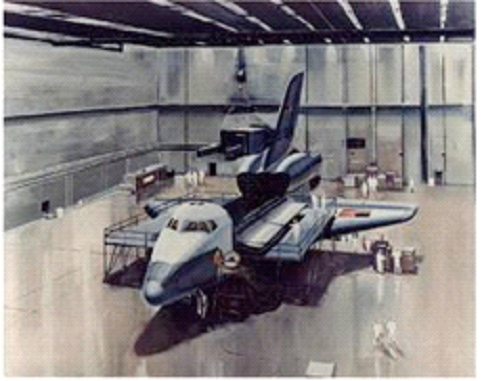
The Shuttle parked in the hanger. Integration for the next mission was supposed to be comparable to Southwest Airlines loading my luggage (maybe I exaggerate a little). This is the Space Shuttle we got:
The Shuttle requires between 200,000 and 400,000 human maintenance hours between each flight! You can barely see the shuttle in the picture above because of the scaffolding surrounding and incasing the vehicle.
Shuttle experts can (and have) elaborated more eloquently than I could on the reasons why the Space Shuttle reusability goals fell so short. But as we prepare for suborbital RLV operations (and hopefully orbital operations) in the not so distant future, I wanted to discuss the implications of an interesting paper by SpaceWorks Engineering (Michael J. Kelly, et al) and its implications for the costs of RLV design & operations.
The paper is called, What’s Cheaper to Fly: Rocket or TBCC? Why? In it, SpaceWorks compares two hypothetical RLV designs (one rocket-based and one turbine-based) and discusses the expected operational costs of both systems. Both designs made the following RLV performance assumptions:
Fleet of three unmanned RLV vehicles
Fleet flies monthly (12/yr)
Every 10 flights, RLVs spend 6-mo in offsite heavy maintenance facility
100 nautical mile LEO orbit
Payload 20K lb.
What I found interesting was what ratio the paper’s authors leveraged from the Space Shuttle program to include in their analysis. The Shuttle utilizes seven support personnel for every one technician in their maintenance and integration efforts. For every one technician preparing the Space Shuttle for its next mission, there are seven individuals supporting that technician. This support staff consists of mission specialists, engineering support personnel, etc. Using this 7:1 ratio, the SpaceWorks paper estimated the need for RLV technicians and then extrapolated the number of support personnel needed.
Using the SpaceWorks rocket-based RLV as an example, below are the costs associated with preparing the rocket for its second flight:
Ignore the exact dollars but pay attention to the percentage. 91% of all “between flight” costs is labor using the 7:1 assumption. Stop worrying about fuel cost – start creating low-maintenance designs. Of course there are other costs that go into the price of an RLV launch: range costs, fixed cost amortization, development cost amortization, etc. But you can see how critical life-cycle costs become in RLV design discussions.
Quoting the paper, “Any program that can do better than 7:1 will probably save significant money over a program that cannot.” And “In addition to considering operational impacts when selecting engines and TPS materials, vehicle designers should strive to eliminate the need for centralized hydraulics, and for auxiliary power units.”
For example, here is what maintenance and integration costs could look like at various improvements to the Shuttle’s 7:1 support personnel to technicians ratio (all other assumptions unchanged):
I end this post with a quote from Byron Ellis, Executive Director of the Jethro Project, on life-cycle cost and Government Acquisition (just as applicable for RLV designers as Government acquisition agents):
“Executive Order 13123 requires government agencies to use life cycle cost analysis (LCCA) to minimize the government’s cost of ownership. Unfortunately, many stakeholders do not understand the concept of cost and proceed to minimize project acquisition (first) cost, rather than total project cost. However, over the life of the project, facility management cost is often two to three times higher than acquisition costs. Therefore, it is essential to design for minimum facility management cost.”
There are two main customer categories for suborbital space flights:
Those that want “the experience” and
Those that want “the view”
Those seeking “the experience” could be adventure seekers valuing the high-g’s, motion sickness, and perceived danger; they could be floaters valuing the micro-gravity free-floating opportunities; or they could be scientists valuing some aspect of the flight profile.
Those seeking “the view” want to see the curvature of the earth, view earth landmarks, see the blackness of space, or take pictures of the stars. These people want an eye-witness account of what space looks like more than an account of what space feels like.
Although most potential customers in category one (“the experience” seekers) are also in category two (“the view” seekers). I doubt the reverse is true. In fact for Virgin Galactic and XCOR, which will be offering suborbital rides that include both both categories of experiences, these companies will sell tickets to "the view" seekers only if there is not a viable alternative for low-intensity, “view only” trips.
bloon is the first product of Spanish startup, zero2infinity, offering customers “the view” of space while enduring a less intense balloon-based ascent instead of a rocket one. The images above are illustrations from the bloon website.
Here is a quick comparison between the two suborbital offerings - excuse the gross generalizations in the rocktet column:
Below is a video where zero2infinity flies the Spanish Soccer team’s red jersey to 33km highlighting the team's recent success at this year’s World Cup. After the video is my interview with zero2infinity’s founder, José Mariano Lopez Urdiales about his plan for the company.
And now my interview with zero2infinity’s founder, José Mariano Lopez Urdiales.
Project-related Questions:
Q: What is bloon? Can you give a summary of your company’s suborbital balloon experience?
José Mariano Lopez Urdiales: Seeing the curvature of the horizon, a black starry sky under a white hot sun and the Earth atmosphere as a blue thin layer protecting our planet from the harshness of the cosmos. It’s a visual experience that many people would like to enjoy. Well, bloon is my company’s solution to the problem of offering that view in a safe, sustainable and enjoyable manner.
Four flight participants lift off vertically in a pressurized piloted pod. The pod soars to near space with the aid of a helium sail. It spends two hours at a cruising altitude of about 36km. The choice of altitude is optimal in terms of experience and safety because it is high enough so that the human eye can appreciate all the visual cues of suborbital flight and not too high to complicate the return with a high-speed re-entry. Flight participants will be able to gaze at our planet through panoramic windows; this is possible because our speeds are always relatively low. Different customers will want to do different things while they are up there, listen to the explanations from the pilots, eat, pray, write a poem, it’s left to their imagination. Every bloon flight is a bespoke experience and privacy can be provided on board. The descent procedure starts and the pod lands on a predefined spot using a guided parafoil and vented airbags. We’ve selected textile-based decelerators because they’ve proven to be the most reliable and safe way of coming back into the atmosphere and landing. The Russian, Chinese, early American and most new American real spacecraft designers seem to agree.
Q: What are the remaining milestones between today and commercial operations?
José Mariano Lopez Urdiales: We are halfway through our fundraising and expect to be done by the end of 2010. The next major milestone is to fly a first human. That will be an experimental flight and could happen as early as late 2011. In 2012 will be mostly busy testing. Then we’ll go through the certification period, first with EASA and later on with the FAA. Certification is a complex issue, many steps have to be certified, the company, the vehicle, the operators, etc. We expect the first commercial operations to take place somewhere between 2013 and 2015.
Q: You mentioned on your website the potential for participants to experience one-third, one-sixth, or microgravity during a portion of the experience. Describe how this is achieved and how long that portion of the experience might last.
José Mariano Lopez Urdiales: Once the pod separates from the balloon, it free-falls and a stabilizer parachute is deployed. The parachute can regulate how much it opens using a cord at its rim. A control system operates that cord using as data input the acceleration felt by the pod. This technique can reproduce different acceleration profiles. Typically lower acceleration levels can be sustained for shorter times. Thus microgravity can be felt for about 20s and lunar gravity could be about a minute and so on.
Q: What training would I need as a participant?
José Mariano Lopez Urdiales: Strictly speaking, with a half a day briefing on security procedures it should be enough. However many participants will likely enjoy other preparatory activities to make the most of their flight. These may include, space photography, basic astronomy, discussions with scientists providing scientific piggyback payloads, etc.
Q: And now a personal question from looking at the graphics on your website, does the bloon cabin include a drink bar and bathroom? With such a long experience(!), as a participant, I would probably appreciate both?
José Mariano Lopez Urdiales: bloon does include both as we want our clients to be as comfortable as possible and to really enjoy the experience. Food to the taste of the clients can also be provided.
Business-related Questions:
Q: What is your source of company funding (Grants, Friends/Family, Angels, VC’s, Bank Loans, etc.)?
José Mariano Lopez Urdiales: After a year funding it myself, I’ve been blessed with angels that have been able to propel the project beyond what I could achieve with my own resources.
Q: How much funding do you need to raise (and how much have you raised to date)?
José Mariano Lopez Urdiales: The whole project requires about €16M in capital. I cannot disclose the amount committed to date as we are in the middle of a funding round.
Q: Your price point of $100K per ticket is half of Virgin Galactic’s. Talk about your pricing strategy (why not $10K, why not $200K?).
José Mariano Lopez Urdiales: You are correct about the ticket price. From our experience, there is another metric that is as important as the ticket, that is the price per minute of experience. Since the view from near space is the core of the experience (who would pay to fly on a windowless spacecraft?), our price is over an order of magnitude below rocket-based alternatives.
We have to cover our costs and make a profit and that sets a minimum, we could not do $10K with our current technology. We are also very keen to provide highly customized solutions such as taking off and landing from a part of the world, or flying into a solar eclipse, to customers willing and able to afford such extras.
Q: Do you see a market in scientific applications?
José Mariano Lopez Urdiales: Definitely. Just as suborbital reusable crewed rockets are an improvement over conventional sounding rockets, and specific programs like NASA’s CRuSR will support them, bloon signifies an improvement over conventional high altitude balloons. Regardless of the overall density of the means to reach near-space (heavier or lighter than air), having a human physically in the loop is an outstanding advantage for research. If it is valuable at labs at ground level and on orbit as well, I do not see why it would not be valuable for intermediate altitudes.
Q: What has been your greatest success to date with bloon?
José Mariano Lopez Urdiales: With so much to do I tend to move on and think of the next steps and challenges rather than reflect on any particulars events of success. If pressured I’d say: we’ve flown and successfully recovered a pressurized scaled prototype to near space altitudes.
Q: What has been your greatest disappointment (or challenge) with bloon, to date?
José Mariano Lopez Urdiales: I had this romantic idea of the venture capital firms as risk takers and out-of-the-box thinkers that, like free spirits, partner with entrepreneurs to change the world at a profit. Well, I have utterly failed to find any of that, and that was a disappointment. Fortunately, other ways of getting funded exist. And if there are any VCs reading that want to prove me wrong, I’d love to hear from you.
Q: What is your next big challenge to overcome?
José Mariano Lopez Urdiales: We are very much concentrated in our first piloted flight to near space.
Q: Your company is founded in Spain, talk about the experience of starting a space-related company in Spain, with its business and regulatory environment.
José Mariano Lopez Urdiales: For some reason many of the brightest students in Spain tend to pick aerospace engineering as a career choice. From my experience in the USA, France and the Netherlands that is not the case there. Law, Computer Science or Biotech are much better magnets for talent there. Full labor costs (wages + insurances) in Spain are significantly lower than in most other advanced economies. Another huge advantage is the absence of ITAR restrictions. We will be able to fly passengers from any nationality, regardless of the embargo status of their home nation. This is an incredible advantage over firms developing in the USA. And the weather here is amazing, which is equally good for quality of life and test flying.
Q: You have attended the International Space University’s Summer Session. Talk about that experience and how it affected this project. Would you recommend ISU’s Summer Session to other budding Space Entrepreneurs?
José Mariano Lopez Urdiales: I would highly recommend the ISU experience; it really helps to get things to happen. I went to ISU in the Chilean winter of 2000 for their two months program. There I worked on two projects, one the creation of a Chilean Space Agency and the other one was titled Space Tourism: from dream to reality. I find remarkable that in 2001 the Agency was setup along the lines of the white paper we prepared at ISU and that very year the first so-called space tourist, Dennis Tito flew to the ISS. That report was the first time I wrote, and as far as I know anybody else, how balloons can offer the benefits that private space explorers desire.
In a recent paper, Ken Davidian of the FAA Office of Commercial Space Transportation, and Jeff Foust of the Futron Corporation have applied Clayton Christensen’s Disruptive Innovation Theory to the suborbital launch industry, predicting the impact of RLV’s on the suborbital market by describing the impacts from multiple technology introduction strategies. The resulting paper provides significant insight.
First a quick summary of Christensen’s Disruptive Innovation Theory (think of this as three strategic options for RLV companies entering the suborbital launch market):
Sustaining Innovation: As an RLV company, enhance one of the current sounding rocket capabilities. Fly higher, reduce g-forces on payloads, reduce cost of launch, reduce purchase-to-launch cycle times, etc. Competition from incumbents will be high. Marketing Risk will be low (you already know the market exists).
Low-End Disruptive Innovation: As an RLV company, offer a lower price than sounding rockets and offer an inferior product (e.g. by not flying as high as a sounding rocket - early RLV’s will offer fewer minutes of quality micro-gravity). Competition from incumbents will be low since this strategy steals the lower margin portion of the market (those customers wanting “a deal”). The incumbent will instead focus on the high-margin portion of the market. Marketing Risk will be low.
New Market Disruptive Innovation: Offer a new capability not offered by sounding rockets. Fly people, return experiments at mission end, fly more than once per day, etc. Incumbents will not be able to compete in the near-term in most cases since current sounding rockets do not offer such capabilities. Marketing risk will be high since new market disruptive innovation must pursue “non-customers” – those not currently served by sounding rockets.
Here are some nuggets from the paper:
The paper argues in favor of Low-End Disruptive Innovation as a preferred strategy for Government customers to support RLV operators – encouraging use of RLV services even before the capabilities of such RLV services fully meet Government needs (or fully matches sounding rocket capabilities). The authors argue this is the best way to help grow a sustainable industry.
Quoting studies from Christensen’s book, Innovator’s Dilemma, new RLV companies would garner a significant first mover advantage by pursuing either of the disruptive innovation strategies mentioned above: new entrants in an established market were successful only 6% of the time while “first mover” new entrants pursuing disruptive innovation strategies were successful 37% of the time. The first move advantage is large!
The paper considered “low-end” suborbital markets to be: earth remote sensing, astronomical & atmospheric observations, technology demonstrations, educational payloads, and novelty payloads that can be performed with only one minute of quality microgravity.
Since 1942, suborbital sounding rocket altitudes are grouped into three categories: 100 kilometers (4 min of microgravity), 300 kilometers (10 min of microgravity), and 300-1500 kilometers (astronomical observation mostly) – with the majority huddled into the 100-300 kilometer range.
The paper predicts according to Christensen’s Disruptive Innovation Theory, early RLV’s will use proprietary technology and be highly integrated, but as more RLV competitors join the market, RLV products will become more modular.
If I had a critique, it would be:
The authors assume the suborbital market would have a large enough “high-margin” market segment to allow incumbents to thrive even while surrendering the low-margin segments to RLV’s. Let’s assume the high-end segment of the suborbital market is any mission significantly over 100 kilometers and the low-end segment is 0-100 kilometers. Looking at the powerful graph on page 11 of their paper, it is clear that the suborbital market is already disproportionately skewed toward the “low-end” portion of the market (although the higher altitude market does appear to be growing). Just by eyeballing the graph I would estimate 35-45% of the suborbital market is 100 kilometers or lower. Would incumbent sounding rockets be able to charge a large enough premium for launches above 100 kilometers to justify losing 35-45% of the market and not retaliate through lower prices?
Remember, I am not doubting the success of RLV introduction into the suborbital market. Instead I am raising doubts on one of the authors’ key conclusions that the sounding rocket incumbents will flee up market rather than retaliate with lower prices. I am not sure the market is large enough for the incumbent to do that. If not, I would expect sounding rocket companies to lower prices to compete with RLV’s even up to 100 kilometers. If, as an RLV operator, you agree with my critique, “New Market” disruptive innovation strategies (although higher marketing risk) may actually make more sense since sounding rockets would not be able to emulate the new RLV-enabled capabilities (in the near-term).
I am a big fan of Clayton Christensen and believe his disruptive innovation theories (especially low-end disruptive innovation) would more perfectly apply to an analysis of Nanosat launchers as a disruptive orbital launch technology. But with that said, Davidian and Foust’s paper provides a great overview of Christensen’s theories and provides significant insight into the future of the suborbital market. And let’s not forget, this is primarily a government paper written to provide recommendations to the US Government on how best they can promote this industry – I do very much like that!