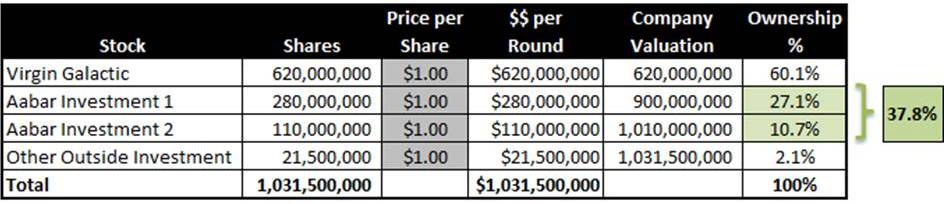
Abu Dhabi’s Aabar made asecond investmentin Virgin Galactic in July, increasing its stake in the company to roughly one-third ownership.This marks the second investment by the Abu Dhabi based fund in the last three years.
Bottom line:
2009 investment for $280M equaled a 31.8% stake.Post Money valuation of $900M.
2011 investment for $110M increased its ownership stake to 37.8%.
Based on this data I estimate one of two scenarios:
Scenario #1: The 2009 investment was a down round with prices per share less than what Virgin had previously valued the company, and the 2011 was an up round.An example of this scenario is provided below.Note the percentage change between share price is valid but the share price itself is not publicly known, so I am using a simplified $1 per share for example purposes.
Scenario #2: The share price has not changed since the company's founding.In addition to the two Aabar investments Virgin has brought in $21.5M from other outside investors.An example of this math is below.
Both of these scenarios match the data provided by Aabar for the last three years.
Reasons for Virgin taking additional investment range from:
1.Preparations for new growth (Nanosat Launch vehicles or other new products)
2.Paying for the delays in reaching commercial operations for its suborbital product
3.Building up a war chest for a rainy day (when money is available sometimes you just take it)
With SpaceX’s announcementthis week that the company would not only develop a reusable first stage for its Falcon 9 family of rockets but would make a completely reusable rocket system (I will use Clark Lindsey’s nomenclature: "rF9" for reusable Falcon 9), I have been wondering about the future of the young NewSpace companies developing reusable suborbital rockets.Will companies like Masten, Armadillo and to a lesser extent XCOR and Virgin Galactic, survive this incursion from a well-funded NewSpace Cousin?
(the youtube video via Clark Lindsey's youtube channel.)
SpaceX has announced the company is developing the “Grasshopper,” a 100 foot-tall suborbital Falcon 9 first stage that SpaceX’s cadre of young, talented engineers will use to test this initial piece of the rF9.SpaceX has NOT announced any intention to commercialize the Grasshopper.But if Masten, XCOR, and Armadillo continue to delay bringing a product to market that can reach 100KM, and SpaceX continues to develop products in its typical rapid fashion, might customers ask to buy payload space on an upcoming Grasshopper test?
Or would SpaceX be willing to sell Grasshoppers to operators who then provide a suborbital launch service to users using the Grasshopper all before Masten has reached 100KM?Could the unmanned Grasshopper be modified to carry passengers and compete with Virgin and XCOR?If an operator came with funding, wouldn’t SpaceX take their money to make the modifications to "manrate" Grasshopper?
But the big money is the orbital market.Most of the suborbital companies have expressed interest in using their suborbital experience and even their suborbital vehicles to expand current offerings to include an orbital system.XCOR has published this image of an orbital capability.
Virgin Galactic even took investment moneyfrom the Middle East to jump start their orbital program.Could an rF9 meet all market demand for both suborbital and ultimately orbital launches as well?And if they do, are the current suborbital companies doomed?
It all comes down to money.
How cheaply could SpaceX really launch their new rF9?We don’t know.SpaceX does not even know yet.But we can make some interesting estimates.The heart of these projected orbital price reductions stems from reusing the rF9 like Southwest reuses its 747’s (which can fly commercially for 30 yearswith proper maintenance). How many reuses is SpaceX planning on?
At this point, the best data I have is a nugget SpaceX's CEO, Elon Musk, said this last week that he is targeting $500K trips to Mars as a market for his reusable craft.
Let’s make some assumptions so we can approximate SpaceX’s reusability assumptions:
A price for a Dragon/Falcon 9 trip to Mars will be equal to the price SpaceX is currently charging NASA for ISS visits ($130M per trip) - optimistic assumption
5 paying passengers per Mars Trip - optimistic assumption
10% profit per launch
All maintenance and between-flight costs are included in the launch price - optimistic assumption
SpaceX breaks even after 47 flights (but that is a lot of assumptions). here is a table to help visualize the math:
Assuming a 47-flight amortization, what could be SpaceX’s breakeven price per KG to LEO?Or to say it another way, how low would the suborbital company’s prices have to be to beat SpaceX?
Again, let’s make some assumptions:
A price for an rF9 to LEO is the same as current LEO Falcon 9
Falcon 9 payload to LEO is unchanged
10% profit per launch
All maintenance and between flight costs are included in the launch price.
Propellant Cost per Launch = $200K
rF9 breaks even after 47 flights
Based on these assumptions, SpaceX's breakeven Price to LEO for rF9 is $130 per KG or ~$1.4M per flight. Again, here is a table to summarize how I came to this conclusion. At the end of this post is a link to an interactive spreadsheet where you can modify these assumptions to create your own analysis.
These SpaceX prices are surely the most optimistic for the near term:
What if the rF9 doesn’t get 47 flights per vehicle?
What if between-flight maintenance costs for the rF9 are significant?
What if payload capacity has to be significantly reduced to accommodate rF9’s reusability elements?
What if near term launch demand is not high enough to fly as often as they need?
Even with the identified risks, this analysis would indicate:
Yes, rF9 could compete against suborbital companies for suborbital market share (especially if SpaceX sells the Grasshoppers to entrepreneur operators)
Yes, rF9 could compete against suborbital companies for orbital market share through extraordinarily low prices
So how can XCOR and Masten compete?
I continue to be bullish regarding the utility of Nanosat-class launch vehicles. When suborbital companies start offering orbital services (a second generation service), their initial orbital offerings would probably be within this Nanosat class - broadly speaking, payload space significantly under 100kg.Is there still a market for suborbital companies to offer this type of orbital service? Even if SpaceX may be able to now match (or beat) them on price?
Yes.Here is why:
Sometimes smaller is better.The smaller vehicles these suborbital companies will eventually offer on orbit should:
Be easier to "fly full"– to get the $130/KG price on an rF9, you have to wait for the manifest to fill.Not so with a smaller vehicle. XCOR was talking about a payload of 12-20KG initially.
Be easier (and cost less) to maintain.
Be launched with less integration or preparation – this advantage is the BIG one. XCOR talks about multiple flights on the same day, taking off and landing from existing airports.Even if the rF9 could launch that often, it will be some time before regulations allow SpaceX to fly that often - especially if they are still flying from the Cape or Vandenberg where ops tempo is measured in "launches per month" not "launches per day".
Nanosat launchers are the future, but only if their ops tempo is fast enough to justify paying a premium for preferential launch windows.
This advantage of the small won’t last forever.SpaceX will keep improving its initial RLV offerings. Spaceport operations will grow to allow for more airline-like ops tempos. So Nanosat launch operators (today’s suborbital companies) will have to keep improving too.
But there is a market for Nanosats and it hinges now on ops tempo. There is hope.
The bigger worry…
…is in the near term.I mentioned earlier, I doubt SpaceX will pursue commercializing their Grasshopper suborbital vehicle.But they may be open to selling this suborbital vehicle for others to operate.Such a suborbital operator flying the Grasshopper would have tremendous suborbital market advantages and could be a major competitor to those suborbital companies focusing on suborbital research (Masten, Armadillo, etc.).
Suborbital companies should be worried, but not panicking.If the reusable Falcon 9 hastens the development of viable Nanosat launchers, the industry will be doubly blessed – low launch costs from the rF9 and high ops tempo from Nanosat launchers.
In October of 2004, I attended the Space Frontier Foundation’s conference in Southern California on the Queen Mary. There, Masten Space Systems made a big splash announcing it was joining Armadillo Aerospace in developing Suborbital RLV’s.
I remember thinking at the time, how did Masten have enough market data to make that decision? Masten, Armadillo, XCOR, Virgin, Blue Origin – these guys & gals threw their hat in the ring long before there were significant studies confirming suborbital RLV’s made “market sense”. They had vision. They had guts. Or if the data did exist, at the time, I did not know how to find it.
And now, NASA is offering a prize for a Nano-satellite Launch Vehicle (NLV) – “launching very small things quite often”. And as candidate NLV teams consider throwing their hats in this ring, the market data is a little more available for an NLV service than there was for suborbital service almost a decade ago.
This post attempts to consolidate that NLV market analysis. Of course this will be incomplete, so I need your help. Add links to other NLV market data in the comments of this post to benefit the whole group. I will skip a discussion of NASA's NLV Challenge. Here is NASA's NLV Challenge Page for more details.
I have broken the NLV market analysis down into the following categories:
NLV Market Sources
Market Overview
NLV Market Differentiators
NLV Substitutes
Interesting NLV Market Nuggets
Potential Market Competitors
Market Demand Graph
NLV Pricing Discussion
Market Impactors
NLV Market Sources. The authors of these study deserve your business. Buy their papers. They are doing good work. Instead of at the end of this post, I wanted these links near the top!
Market Overview. The NLV market can be dissected in at least two ways: (1) by payload size and (2) by payload type.
Payload Size. I have heard various naming conventions for small payload launch vehicles. For this blog post, I will use “Nano”, “Micro”, “Small” as three payload sizes to consider. However, I will group them all together and use the name NLV most of the time.
Nano - Under 10kg
Micro - 10-100 kg
Small - 100-200 kg
NASA is focused on a 1kg payload for its NLV Challenge. The Army is interested in at least 20kg payloads. Even if first generation vehicles are only able to launch a few kg of payload, commercial NLV ventures would be wise to endeavor to grow to larger payload sizes over time. Current 200-400kg payloads launched currently on larger vehicles would surely be interested in "going on a diet" if an NLV launcher could carry 100-200Kg yet offer more frequent launches.
Payload Type. The second NLV market subdivision will be the option of (1) launching a functioning satellite or (2) delivering cargo to stations or depots. Of the two, cargo delivery may very well be the larger of the two sub-markets. It will take far less preparation to send the ISS an NLV-load of fresh apples than it would be to fund, develop, integrate, and launch a nanosat. Both satellite launches and cargo delivery will be sub-markets. Expect the satellite market to retain a diversified customer base. Expect the cargo delivery customer base to be dominated by station owners in the early days (ISS partners and Bigelow), but to expand to Space Station customers in the not so distant future (see: NanoRacks).
NLV Market Differentiators. What makes an NLV unique? An NLV won’t be able to carry as much payload to orbit as its bigger cousins, why would any customers want to use an NLV? Answer: Frequent launches, low integration time.
Cost: Higher Cost per LB than larger launchers but lower Cost per launch
Launch Frequency: Launch *much* more frequently than larger launchers (weekly? Daily?)
Launch Lead Time: Integrate payloads in less time to take advantage of more frequent launches
Payload Mass: a few kg (at first)
Orbit Choice: Customers can choose since not a secondary payload
Suborbit/LEO/GEO: Limited to LEO (at first) – Suborbital applications? Maybe.
NLV Substitutes. Prices for NLV’s cannot be set independent of substitutes. Here’s a list of some big ones:
Launch as secondary payload. Spaceflight Services (Andrews Space) offers a turnkey solution for your payload to fly on the BIG rockets as a secondary payload.
Hosted payloads. Boeing just launched a new service to combine your payload with others on a single satellite bus thus reducing customer costs since they do not need to procure an entire satellite. Note: this would be a substitute only for satellite payloads, not for cargo payloads
Commercial RLV suborbital spaceflight. Masten, Armadillo, and Blue Origin are stuck at 100km for now, but not for long. Watch as future generations of their vehicles climb higher and higher giving customers a greater flight-time, frequent launches, and very low costs.
With COTS deliveries to ISS approaching, deliveries to station will be made by NASA several times per year with ISS partners also delivering cargo to station several times per year.
Interesting NLV Market Nuggets.
Microcosm Inc, identified potential market-wide launch savings of more than $15B over a 12-year period, resulting from the development of a low-cost responsive launch vehicle focused on the SmallSat market (above 100Kg)
In a 2008 presentation, Pete Worden said there were ~80 universities with active cubesat (nanosat) programs
A 2006 Futron Study identified over 30 markets in 6 principle areas for services provided by low-cost satellites in the 100-200 kilogram class
The US Army is interested in Nano Launch and had put a price point of $1M per launch.
My interview with the CEO of CubeSat component manufacturer Clyde Space revealed he thought $250K for a 3u is definitely too much for most customers.
My interview with Professor Jordi Puig-Suari from Cal Poly and professors from MIT, and St. Louis University who are currently active in either university satellite development or active in space research of some kind show they are targeting a price point under $50K per CubeSat with $20K being preferred. Relooking at my notes from those interviews, at a $20K price point, these professors thought the US demand for CubeSat launches would grow to 50-100 each year. Interesting they thought the low flight opps of the current “secondary payload” system a bigger problem than the high cost. Prof Michael Swartwout said in my interview with him, he waits 5-7 years to secure a spot on a rocket to launch his CubeSats. This is longer than an undergrads college career – not too inspiring for young engineers!
Potential Market Competitors. Non-exhaustive – From the Paper: "Market Characterization: Launch of Very-Small and Nano Sized Payloads" by Christsensen, et all. 2010.
Market Demand Graph:
This graph is incomplete but should convey the significant number of different areas where an NLV could gain market share. For an explanation of these categories I would encourage you to get a copy of the wonderful papers I list under the “sources” section of this post.
NLV Pricing Discussion. A major portion of any market analysis is not just what the needs are but what are potential customers willing to pay to meet those needs. For the NLV market you have customers at different ends of a spectrum. Government customers like the Army have stated a willingness to pay $1M to place 20kg in LEO. Universities want to keep Cubesat costs (usually 1-3 kg) to under $20K per U.
Variable Pricing seems like the right answer, where Primary customers pay a premium to fly on their schedule to their orbit and others willing to fly “standby” get a much reduced price but operate on someone else’s schedule and flies to someone else’s orbit. Rather than rewrite the variable pricing details now, here is the post I wrote on variable NLV pricing a few months ago.
If you made me guess right now, I would assume the following prices per U would be acceptable by the market:
Government: $50-200K per U (with discounts per U for larger payloads)
Academia: $20K per U
Commercial: ???, perhaps somewhere between
Market Impactors. Any market has externalities to the market that can help or hurt the industry. Here are just a few:
Of all of the substitutes available to the NLV market, the one that has most potential to steal market share is the second or third generation of suborbital RLV’s. As mentioned earlier in this post, a subset of the NLV market could be served with the extended micro-gravity offered by suborbital RLV’s flying to 500 or 1000 km. But the opposite is also true, a delay or accident affecting the un-manned portion of the suborbital RLV industry (primarily Masten, Armadillo, and Blue Origin) could make some customers consider launching on an NLV rather than waiting for the suborbital ride.
One of the two key sub-markets for NLV’s will be package delivery. More successful space stations, more package delivery. The proliferation of commercial space stations will be a major driver of this sub-market
How the last mile problem gets solved will directly affect the viability of micro package delivery (one of my two submarkets). We need solutions for the last mile problem – the solution will be part technology, part policy, part management. If NLV packages can’t be routinely delivered to space stations, the NLV industry will be severely hampered and space stations will miss out on an enabling method to gain just-in-time deliveries.
NLV’s only work as a market if they can launch frequently with low integration turnarounds. Even if low costs had to come later, the ability to launch frequently with streamlined payload integration will be the driving force behind early NLV success stories. The question operators will need to ask is, “How do I design and manage NLV operations in such a way to achieve the goals of frequent flight opps and low integration turnarounds?”
Although depot development is still years down the road, the potential “match made in heaven” between depots need for frequent propellant deliveries and NLV’s ability to fly frequently should not be overlooked…but I would not build a business plan around depot assumptions just yet.
That is a good dataset to start. I will add some commentary in future posts. Here is the spreadsheet containing the tables used in this post.
Now I welcome your additions. Use the comments section to your links to even more NLV market data.
There are two main customer categories for suborbital space flights:
Those that want “the experience” and
Those that want “the view”
Those seeking “the experience” could be adventure seekers valuing the high-g’s, motion sickness, and perceived danger; they could be floaters valuing the micro-gravity free-floating opportunities; or they could be scientists valuing some aspect of the flight profile.
Those seeking “the view” want to see the curvature of the earth, view earth landmarks, see the blackness of space, or take pictures of the stars. These people want an eye-witness account of what space looks like more than an account of what space feels like.
Although most potential customers in category one (“the experience” seekers) are also in category two (“the view” seekers). I doubt the reverse is true. In fact for Virgin Galactic and XCOR, which will be offering suborbital rides that include both both categories of experiences, these companies will sell tickets to "the view" seekers only if there is not a viable alternative for low-intensity, “view only” trips.
bloon is the first product of Spanish startup, zero2infinity, offering customers “the view” of space while enduring a less intense balloon-based ascent instead of a rocket one. The images above are illustrations from the bloon website.
Here is a quick comparison between the two suborbital offerings - excuse the gross generalizations in the rocktet column:
Below is a video where zero2infinity flies the Spanish Soccer team’s red jersey to 33km highlighting the team's recent success at this year’s World Cup. After the video is my interview with zero2infinity’s founder, José Mariano Lopez Urdiales about his plan for the company.
And now my interview with zero2infinity’s founder, José Mariano Lopez Urdiales.
Project-related Questions:
Q: What is bloon? Can you give a summary of your company’s suborbital balloon experience?
José Mariano Lopez Urdiales: Seeing the curvature of the horizon, a black starry sky under a white hot sun and the Earth atmosphere as a blue thin layer protecting our planet from the harshness of the cosmos. It’s a visual experience that many people would like to enjoy. Well, bloon is my company’s solution to the problem of offering that view in a safe, sustainable and enjoyable manner.
Four flight participants lift off vertically in a pressurized piloted pod. The pod soars to near space with the aid of a helium sail. It spends two hours at a cruising altitude of about 36km. The choice of altitude is optimal in terms of experience and safety because it is high enough so that the human eye can appreciate all the visual cues of suborbital flight and not too high to complicate the return with a high-speed re-entry. Flight participants will be able to gaze at our planet through panoramic windows; this is possible because our speeds are always relatively low. Different customers will want to do different things while they are up there, listen to the explanations from the pilots, eat, pray, write a poem, it’s left to their imagination. Every bloon flight is a bespoke experience and privacy can be provided on board. The descent procedure starts and the pod lands on a predefined spot using a guided parafoil and vented airbags. We’ve selected textile-based decelerators because they’ve proven to be the most reliable and safe way of coming back into the atmosphere and landing. The Russian, Chinese, early American and most new American real spacecraft designers seem to agree.
Q: What are the remaining milestones between today and commercial operations?
José Mariano Lopez Urdiales: We are halfway through our fundraising and expect to be done by the end of 2010. The next major milestone is to fly a first human. That will be an experimental flight and could happen as early as late 2011. In 2012 will be mostly busy testing. Then we’ll go through the certification period, first with EASA and later on with the FAA. Certification is a complex issue, many steps have to be certified, the company, the vehicle, the operators, etc. We expect the first commercial operations to take place somewhere between 2013 and 2015.
Q: You mentioned on your website the potential for participants to experience one-third, one-sixth, or microgravity during a portion of the experience. Describe how this is achieved and how long that portion of the experience might last.
José Mariano Lopez Urdiales: Once the pod separates from the balloon, it free-falls and a stabilizer parachute is deployed. The parachute can regulate how much it opens using a cord at its rim. A control system operates that cord using as data input the acceleration felt by the pod. This technique can reproduce different acceleration profiles. Typically lower acceleration levels can be sustained for shorter times. Thus microgravity can be felt for about 20s and lunar gravity could be about a minute and so on.
Q: What training would I need as a participant?
José Mariano Lopez Urdiales: Strictly speaking, with a half a day briefing on security procedures it should be enough. However many participants will likely enjoy other preparatory activities to make the most of their flight. These may include, space photography, basic astronomy, discussions with scientists providing scientific piggyback payloads, etc.
Q: And now a personal question from looking at the graphics on your website, does the bloon cabin include a drink bar and bathroom? With such a long experience(!), as a participant, I would probably appreciate both?
José Mariano Lopez Urdiales: bloon does include both as we want our clients to be as comfortable as possible and to really enjoy the experience. Food to the taste of the clients can also be provided.
Business-related Questions:
Q: What is your source of company funding (Grants, Friends/Family, Angels, VC’s, Bank Loans, etc.)?
José Mariano Lopez Urdiales: After a year funding it myself, I’ve been blessed with angels that have been able to propel the project beyond what I could achieve with my own resources.
Q: How much funding do you need to raise (and how much have you raised to date)?
José Mariano Lopez Urdiales: The whole project requires about €16M in capital. I cannot disclose the amount committed to date as we are in the middle of a funding round.
Q: Your price point of $100K per ticket is half of Virgin Galactic’s. Talk about your pricing strategy (why not $10K, why not $200K?).
José Mariano Lopez Urdiales: You are correct about the ticket price. From our experience, there is another metric that is as important as the ticket, that is the price per minute of experience. Since the view from near space is the core of the experience (who would pay to fly on a windowless spacecraft?), our price is over an order of magnitude below rocket-based alternatives.
We have to cover our costs and make a profit and that sets a minimum, we could not do $10K with our current technology. We are also very keen to provide highly customized solutions such as taking off and landing from a part of the world, or flying into a solar eclipse, to customers willing and able to afford such extras.
Q: Do you see a market in scientific applications?
José Mariano Lopez Urdiales: Definitely. Just as suborbital reusable crewed rockets are an improvement over conventional sounding rockets, and specific programs like NASA’s CRuSR will support them, bloon signifies an improvement over conventional high altitude balloons. Regardless of the overall density of the means to reach near-space (heavier or lighter than air), having a human physically in the loop is an outstanding advantage for research. If it is valuable at labs at ground level and on orbit as well, I do not see why it would not be valuable for intermediate altitudes.
Q: What has been your greatest success to date with bloon?
José Mariano Lopez Urdiales: With so much to do I tend to move on and think of the next steps and challenges rather than reflect on any particulars events of success. If pressured I’d say: we’ve flown and successfully recovered a pressurized scaled prototype to near space altitudes.
Q: What has been your greatest disappointment (or challenge) with bloon, to date?
José Mariano Lopez Urdiales: I had this romantic idea of the venture capital firms as risk takers and out-of-the-box thinkers that, like free spirits, partner with entrepreneurs to change the world at a profit. Well, I have utterly failed to find any of that, and that was a disappointment. Fortunately, other ways of getting funded exist. And if there are any VCs reading that want to prove me wrong, I’d love to hear from you.
Q: What is your next big challenge to overcome?
José Mariano Lopez Urdiales: We are very much concentrated in our first piloted flight to near space.
Q: Your company is founded in Spain, talk about the experience of starting a space-related company in Spain, with its business and regulatory environment.
José Mariano Lopez Urdiales: For some reason many of the brightest students in Spain tend to pick aerospace engineering as a career choice. From my experience in the USA, France and the Netherlands that is not the case there. Law, Computer Science or Biotech are much better magnets for talent there. Full labor costs (wages + insurances) in Spain are significantly lower than in most other advanced economies. Another huge advantage is the absence of ITAR restrictions. We will be able to fly passengers from any nationality, regardless of the embargo status of their home nation. This is an incredible advantage over firms developing in the USA. And the weather here is amazing, which is equally good for quality of life and test flying.
Q: You have attended the International Space University’s Summer Session. Talk about that experience and how it affected this project. Would you recommend ISU’s Summer Session to other budding Space Entrepreneurs?
José Mariano Lopez Urdiales: I would highly recommend the ISU experience; it really helps to get things to happen. I went to ISU in the Chilean winter of 2000 for their two months program. There I worked on two projects, one the creation of a Chilean Space Agency and the other one was titled Space Tourism: from dream to reality. I find remarkable that in 2001 the Agency was setup along the lines of the white paper we prepared at ISU and that very year the first so-called space tourist, Dennis Tito flew to the ISS. That report was the first time I wrote, and as far as I know anybody else, how balloons can offer the benefits that private space explorers desire.