Showing posts with label CubeSat. Show all posts

Friday, September 7, 2012

Would a Reusable Falcon Hurt SpaceX?

What happens if SpaceX is successful at achieving its Falcon reusability goals.  Here is the video of SpaceX’s plans to recover and reuse the majority of its Falcon launch system.


Let me make some assumptions about a Reusable Falcon (R-Falcon) to make my point that such a system may pose challenges for SpaceX.

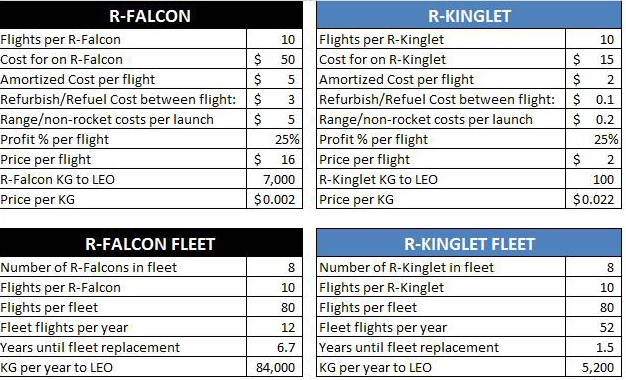
On the surface, an R-Falcon would be great.  If my assumptions below are accurate, only $16M per flight, a flight every 30 days, only two thousand dollars per KG.  From a consumer perspective this would be great!  SpaceX is adding reusability to the large rockets they already have.  And they will probably be successful at it.  They do seem to achieve what they put their mind to, however, could there be an easier road to reusability?  Let’s explore the possibility.  First what could a large reusable system like SpaceX’s look like (dollars values in millions)?

  
I am still amazed we can’t build Saturn V’s today.  We built them before.  We went to the moon in them for goodness sake!  We knew how to build them…why don’t we know now?  Two major reasons:
  1. We don’t have the tooling/plans – long since destroyed or lost
  2. We don’t have the knowledge – the NASA/contractor engineers have retired/passed away
 Surely such a reusable system like the R-Falcon could avoid these Saturn-V pitfalls…right?  If you look at the table above you see I estimated SpaceX builds eight initial R-Falcons.  This high number addresses the unknowns about number of flights per R-Falcons.  Will it really be 10 flights per vehicle as I estimate?  And how long will it take technicians to refurbish and integrate the next payload? 6 weeks?  8 weeks?  With flights every month and 6-8 week refurbish and integration windows, multiple R-Falcons will be needed.

So here is the problem.

After the initial push to develop the R-Falcon fleet, at the usage rates outlined in the table, you would NOT NEED TO BUILD another R-Falcon for 6.5 years!

So SpaceX could avoid throwing away their tooling (unlike the Saturn V), but could they keep a knowledgeable team around ready to build the next R-Falcon 6.5 years after the first fleet was completed?

And even if you believe eight R-Falcons in the initial fleet is too many and want to reduce the fleet size, demand rates of one per month means SpaceX would only need to make approximately one R-Falcon per year to keep up with demand.  Not exactly mass production – 1 vehicle per year.  Can you keep the production team “sharp” on 1 vehicle per year?

How can it be, as a consumer, I love the R-Falcon (yay $2k per KG), but as a business, could the R-Falcon be a bad way to prove a reusable launch vehicle?  Could the R-Falcon launch too much payload and launch too infrequently?

Let’s talk about an alternate business approach that could address some of these challenges.  I said above that my hypothetical R-Falcon has two problems:
  •  Launching too much payload
  • Launching too infrequently
How could a new hypothetical company do reusable launch better?  What if you launch less mass but launch more often?  So let’s make up a hypothetical launch system – the “Kinglet.”  Since this is a business blog, let’s not get bogged down into the technical details except that instead of launching 7,000KG per flight, the Kinglet will launch 100KG.  And instead of paying the R-Falcon’s $5M for range access per flight, the Kinglet pays $200K per flight for its range or range-like services (airport, spaceport, other?).  Here is the table for such a system (dollars values in millions).


The Kinglet is a smaller launch system but aims for a higher flight rate, targeting weekly flights instead the R-Falcon’s monthly flight rate.  As a potential customer, I do not like the 10x higher price I pay to use Kinglet ($20K per KG vice the Falcon’s $2K).  But flying weekly may be attractive to some customers.  Overall though, this appears to be bad for customers (most customers could wait a month to fly).  But from a business perspective, all things being equal, a small reusable launch system like Kinglet has a much higher probability of success because it starts small.

Where the Falcon struggled to keep its production line open with only one new vehicle per year, the Kinglet will need to produce five systems per year to keep up with demand.  Now five launch vehicles per year is still not mass production, but those volumes will, not only keep the production team sharp, but provide five times the opportunities to roll in product and production improvements into the newer vehicles than would be possible on the R-Falcon production line.

Could a smaller reusable system avoid R-Falcon's hidden pitfalls?  Maybe.

So the last question to ask is, what needs to be launched at least weekly with a mass of under 100KG? 

Here is the excel file with tables from this post if you want to change the assumptions.

Tuesday, November 22, 2011

SpaceWorks Nanosat Market Study

SpaceWorks Commercial today released their latest nano/microsatellite market study.  You can download it here.  The study is quite bullish on the growth of Nanosatellites over the next decade with over 20% growth per year through 2014. 

If you are a regular reader of this blog, you know I am a big advocate for Nanosats and Nanosat launchers .  But I do want to caution us that the authors of this analysis are also developing the Generation Orbit Nanosat launch vehicle.  Some may doubt how unbiased their nanosat market study can be when they are developing a vehcile to launch them.  However, the counter argument could also be, it was reviewing this same market data several months ago (now made public) that led som of the folks over at SpaceWorks to start Generation Orbit in the first place.

Here are a few highlights from the report.  Note many of these comments are direct quotes from the SpaceWorks study itself:
  • 180 known future nano/microsatellites to launch by 2014
  • Range of 100-142 nano/microsatellites (1-50kg) that will need launches globally in the year 2020 (verses 23 in 2011)
    • 32 are estimated to be 11-50kg satellites
    • 68 are estimated to be 1-10kg satellites
    • 75% expected to be foreign or academic payloads
    • Military growth accounts for the majority of the delta between the 100 launch estimate and the 142 launch estimate for 2020
  • New Program list of Known NanoSats:
    • QB50 – 50 Cubesats to be launched between 2013 and 2014
    • NRO Colony I – 12 Cubesats to be launched over next few years
    • NRO Colony II – 20-50 Cubesats to be launched following Colony I
    • ALASA – 36 mirosatellites to be launched beginning in 2015
  • The number satellites launched may not equal the  number of launches since many satellites are multiple-manifested
  • 4.38% growth in Nano/microsatellite launch demand since 2000
  • 22.5% growth (!) in Nano/microsatellite launch demand expected from 2011-2014
  • Market saturation point was set at 150 launches per year (the projected 2030 value) (however SpaceWorks admits that some estimates project CubeSat launches at over 600 per year – well above their 150 launch ceiling)
  • For a fee, Customers can license SpaceWorks more detailed database of nano/microsatellites

Additionally, the SpaceWorks estimates in this market study are based on growth in popularity of Nanosatellites and Microsatellites on existing launch vehicles (with the possible exception of the launches connected with ALASA).  As soon as you CAN launch every week or day on board a new generation of quick response Nanosat launchers, many new uses will be found for this class of satellite.  And many new customers, yet to be identified, will be taking advantage of such frequent access to space.

Thursday, July 7, 2011

Interview with Dr. Steven Tsitas - Cubesat Earth Imaging Constellations

This week I interviewed Dr Steven Tsitas of the Satellite Navigation and Positioning Lab and lead author of the paper, “6U CubeSat design for Earth observation with 6.5m GSD, five spectral bands and 14Mbps downlink.”  This paper has been peer reviewed, and appears in the November 2010 issue of The Aeronautical Journal which is published by the Royal Aeronautical Society. I analyzed the business potential of such a cubesat constellation in a previous post here.

Dr. Steven Tsitas received his BSc(Hons) in Physics from the University of Melbourne, MS in Physics (with Distinction) from California State University Fresno and MS and PhD in Planetary Science with a minor in Astronomy from the California Institute of Technology. His two part PhD thesis title is The effect of volcanic aerosols on ultraviolet radiation in Antarctica and A novel method for enhancing subsurface radar imaging using radar interferometry. After completing his PhD Steven worked as a Management Consultant at Bain & Co. in San Francisco. He recently completed a MSc in Astronautics and Space Engineering at Cranfield University, receiving the Vega Space Systems Engineering Prize for Excellent Performance in Dynamics Related Subjects 2008/2009. His most recent papers detail the system design and commercial applications for an 8 kg, 6U CubeSat that can perform Earth observation missions equivalent to those of current 50-150kg microsatellites, with a corresponding reduction in cost.

And now my conversation with Dr. Tsitas:

Q: Your paper posits the potential of a constellation of cubesat earth imaging satellites capable of performing their job on par with current industry leaders like the European company Rapideye. To fit so much capability into a 6U Cubesat is incredibility daunting. What innovations are you proposing to accomplish this?

Steven Tsitas: I employ several innovations to make such a solution possible:
  • Time Delay Integration (TDI) to allow a small imager to collect as much light as a larger aperture; 
  • Determining attitude during imaging by rate integration using a Fiber Optic Gyroscope to meet the requirements for pointing stability following from the use of TDI; and 
  • DVB-S2 encoding and a three speed transmitter to allow fast downlink from such a small spacecraft.
One of the things that I like about space engineering is you can twist and turn around obstacles to find solutions - it is quite a creative process. However the design process isn't arbitrary, the culture of space engineering is to design to requirements, and if done well every component in the spacecraft can be traced to a top level requirement through a process of step by step logical decisions. Just as a limited palette doesn't limit an artist, this logical discipline doesn't have to limit creativity in the design of spacecraft.

Q. RapidEye produces images in five spectral bands including infrared – does your proposed 6U system do the same?

Steven Tsitas: Yes, it images in the same 5 spectral bands as RapidEye.

Q. RapidEye produces a 6.5-meter resolution image – what resolution image does your proposed 6U system produce?

Steven Tsitas: 6.5 m Ground Sample Distance (GSD), the same as RapidEye.

Q. RapidEye admits their 6.5-meter resolution is not adequate for some commodity customers like those tracking crops like grapes, strawberries, and peanuts. What is the highest resolution (better than 5-meter?) that you believe possible today in a 6U?

Steven Tsitas: Good images aren't just about resolution, but also having good contrast at medium spatial frequencies. This is quantified by the Modulation Transfer Function. I've seen a high resolution image with poor contrast at medium spatial frequencies, and it looked much worse than an image of the same scene with lower resolution but higher MTF at mid spatial frequencies. I could improve the GSD of the 6U CubeSat design at the expense of contrast, but this wouldn't necessarily give better or more useful images. Fundamentally resolution is limited by aperture size, and the 6U CubeSat design has an 89 mm aperture imager. Given the 6U CubeSat is just 100 mm thick this is obviously close to the limit. Short of some kind of foldable optics or deployable membrane mirror technology I don't think you are going to do much better than that with 6U.

Q. RapidEye’s satellites are designed to last seven years – your research indicates a 12 year satellite life per 6U. How would the orbital life of each satellite change by offering the RapidEye service of a photo anywhere on earth within 24 hours?

Steven Tsitas: To be clear, the paper indicates that the orbital lifetime could be 12 years, and in fact could exceed 25 years requiring a deorbit device, for which provision is made in the design. The orbital lifetime is not necessarily the same as the operational lifetime. Regarding the effect of imaging operations on operational lifetime, the 6U CubeSat design does not include propulsion or any consumables, so there is no direct link between a particular imaging campaign and the operational lifetime of the spacecraft.

Q. In a recent post, I speculate on the economics of a such a 6U cubesat constellation. What further are you planning in this area?

Steven Tsitas: I discuss the commercial implications of the 6U CubeSat design in an upcoming paper. Standby.  Perhaps we can continue this conversation after the release of the new paper.


Thank you Steven. Yes, let’s talk again with the release of your paper on the economics of such a cubesat system.

Tuesday, May 31, 2011

Business Case for a CubeSat-based Earth Imaging Constellation

The use of Commercial Earth Imaging Satellites is growing. Individuals, corporations and governments are finding varied and unique applications for images of our planet.

Futron estimates the market for commercial earth imaging topped $1B last year (2010).


Uses of Earth Imaging:
  • Disaster Relief – think of all of the satellite images you saw after the Japan Earthquake (including the nuclear reactors)
  • Disaster avoidance - George Clooney (among others) paying to patrol boarder of north and south Sudan using Earth imaging satellites.
  • Helped with hunting down Osama bin Laden (but were any these images from commercial satellites?)
  • Food Commodities tracking – allowing traders to ask and answer questions like, “how do the wheat crops in Kansas look after last night’s hail storm?”
  • Remote Infrastructure observation – the oil industry uses it to keep track of their assets in remote locations
  • Even the US Government is turning to Commercial providers. Last year, the U.S. National Geospatial-Intelligence Agency (NGA) awarded separate 10-year, $3.5 Billion contracts to image providers DigitalGlobe and GeoEye (these contracts are now under review).

The Commercial earth observation markets:
  1. Market #1: High-Resolution images (1.5 meters per pixel). But the cost of each satellite means providers have a limited number of satellites (usually 1-2) on orbit.
  2. Market #2: Med-Resolution images (5-7 meters per pixel) – lower quality images, but providers tend to have more satellites in orbit and may offer more spectral bands to choose from for each image and offer more frequent photo opportunities due to the higher number of satellites within the constellation.


In a recent Nov 2010 paper, “6U CubeSat design for Earth observation with 6.5m GSD, five spectral bands and 14Mbps downlink,” author, Dr. Steven Tsitas outlines how a constellation of 6U CubeSats could serve Market #2 (frequent med-res images) competitively. (Sorry, I think you will have to buy the paper. If a reader finds a free version of the paper online, let me know and I will change the link). I hope to post an interview with Steven Tsitas soon.

But why even consider a CubeSat at all for such a mission? Here are just a few of the advantageous of using CubeSats:
  • High amount of innovation in the field – from NASA, universities, and private industry
  • Low ITAR restrictions (CubeSat programs are thriving in many nations)
  • Low mass of each satellite
  • Reduced launch cost per satellite
  • Reduced cost to replace/upgrade constellation as satellites age, breakdown, or new technology becomes available

Rapid Eye, a German company, is the current leader serving Market #2. Below I will provide some details about Rapid Eye and how a CubeSat constellation might be able to compete with Rapid Eye.  First, a little education about Rapid Eye.

Rapid Eye Details:
  • Five identical sun-synchronous Earth observation satellites
  • Five spectral bands
  • Launched in August 2008
  • Satellites built by Surrey UK
  • 650KM circular orbit
  • Captures 4mil km squared of earth’s surface every day
  • Once an order is placed for an image, can take a photo of any location on earth (between 75 degrees N and 75 degrees S) within 24 hours.
  • Offers not only images, but offers services for the analysis of images – especially good at providing comparative analysis of images taken over a period of time

Rapid Eye, the Numbers:
  • Customer price for images: $1.33 per square KM (must purchase 5,000 KM at a time (at current Euro conversation rates that is equal to $6650 per very large image)
  • Satellite Constellation construction: $35M 
  • Expected 2009 Revenue: $29.5M (have not confirmed this number)
  • Total Capital needed to break even: $224M

Assumptions about Rapid Eye’s business:
  • Assumed Rapid Eye is now profitable
  • Assumed the cost of the single Dnepr launch necessary to lift the five Rapid Eye sats: $15M
  • Assumed a $50M infrastructure Hardware purchase (ground station and other startup infrastructure)
  • Assumed a five year startup at a cost of ~$25M per year in operating (non-HW, non-infrastructure costs)


So what if we could launch a constellation of ten cubesats that could perform a very similar function as Rapid Eye’s current constellation of five small sats? Are their savings if we could? For this post, I will use Steven Tsitas’s conclusions that, yes, such a cubesat constellation would be technically possible.

I will build my business case, not from a technology discussion, but by attempting to answer the business question of - how much could an business save by using Cubesats instead of small sats?

CubeSat Venture Assumptions:
  • Cost per 6U CubeSat: $400,000
  • Number of CubeSats in constellation: 10
  • 6U CubeSat mass: 8 lbs each
  • Falcon 1 launch: $9.8M
  • SpaceX willing to prorate launch cost based on mass

If we assume the CubeSat venture would operate using the same Hardware and Operating Costs as the Rapid Eye venture, then the CubeSat savings are limited to the cost of the satellites themselves and the cost to launch them into orbit:
  • Rapid Eye’s satellite and launch costs: 23% of breakeven costs
  • CubeSat venture’s satellite and launch costs: 3% of breakeven costs
This would mean a CubeSat venture competing with Rapid Eye could theoretically lower image prices by twenty percentage points over competitors (all other things being equal). This by itself may close the business case for some CubeSat constellation investors.


But perhaps competing toe-to-toe with Rapid Eye is the wrong business model. As a general rule, it is hard to out Wal-Mart, Wal-Mart. What-if the CubeSat earth imaging venture could, instead, become the low-price, no frills, earth imaging provider?

In the earlier example, the CubeSat advantage was limited to lower satellite costs and cheaper rides to orbit on SpaceX launch vehicles. But what-if the venture could also save money on ground costs: Hardware/ground stations and operating expenses?

CubeSats, the low-cost leader in earth imaging Assumptions:
  • Continue with assumptions regarding low satellite costs
  • Continue with assumptions regarding low launch costs
  • Lower ground Hardware and Infrastructure costs from $50M to $25M
  • Lower operating costs from $25M to $10M per year.


Here is a quick cost comparison between the options:


Next Questions (beyond the scope of this post):
  • Market price elasticity: How price sensitive is the earth imaging market? How would cutting Rapid Eye’s price by 20-60% affect demand for a CubeSat-based image product?
  • What realistic cost reduction methods are possible in ground hardware and personnel?
  • Admittedly, my Rapid Eye information was limited to publicly available data, a more serious effort should be conducted to understand the competitor’s cost structures and current profit forecasts
  • What are the cost implications from using a CubeSat-based system? Where are system costs reduced? Where are system costs increased?
  • Admittedly, images from a CubeSat are of a lower quality than the best in orbit (5-7 meters per pixel compared to 1.5 meters per pixel from the industry leaders of market #1).  How sensitive is the market to image quality?  And what can be done to increase the quality of an image taken on a 6U CubeSat?

Sunday, March 6, 2011

NLV Market Analysis

Garvey's Prospector 7C
In October of 2004, I attended the Space Frontier Foundation’s conference in Southern California on the Queen Mary. There, Masten Space Systems made a big splash announcing it was joining Armadillo Aerospace in developing Suborbital RLV’s.

I remember thinking at the time, how did Masten have enough market data to make that decision? Masten, Armadillo, XCOR, Virgin, Blue Origin – these guys & gals threw their hat in the ring long before there were significant studies confirming suborbital RLV’s made “market sense”. They had vision. They had guts. Or if the data did exist, at the time, I did not know how to find it.

And now, NASA is offering a prize for a Nano-satellite Launch Vehicle (NLV) – “launching very small things quite often”. And as candidate NLV teams consider throwing their hats in this ring, the market data is a little more available for an NLV service than there was for suborbital service almost a decade ago.

This post attempts to consolidate that NLV market analysis. Of course this will be incomplete, so I need your help. Add links to other NLV market data in the comments of this post to benefit the whole group. I will skip a discussion of NASA's NLV Challenge.  Here is NASA's NLV Challenge Page  for more details. 
I have broken the NLV market analysis down into the following categories:
  • NLV Market Sources
  • Market Overview
  • NLV Market Differentiators 
  • NLV Substitutes
  • Interesting NLV Market Nuggets
  • Potential Market Competitors
  • Market Demand Graph
  • NLV Pricing Discussion
  • Market Impactors

NLV Market Sources.  The authors of these study deserve your business. Buy their papers. They are doing good work. Instead of at the end of this post, I wanted these links near the top!

Market Overview.  The NLV market can be dissected in at least two ways: (1) by payload size and (2) by payload type.

Payload Size. I have heard various naming conventions for small payload launch vehicles.  For this blog post, I will use “Nano”, “Micro”, “Small” as three payload sizes to consider.  However, I will group them all together and use the name NLV most of the time.
  • Nano - Under 10kg
  • Micro - 10-100 kg
  • Small - 100-200 kg
NASA is focused on a 1kg payload for its NLV Challenge. The Army is interested in at least 20kg payloads. Even if first generation vehicles are only able to launch a few kg of payload, commercial NLV ventures would be wise to endeavor to grow to larger payload sizes over time. Current 200-400kg payloads launched currently on larger vehicles would surely be interested in "going on a diet" if an NLV launcher could carry 100-200Kg yet offer more frequent launches.

Payload Type. The second NLV market subdivision will be the option of (1) launching a functioning satellite or (2) delivering cargo to stations or depots. Of the two, cargo delivery may very well be the larger of the two sub-markets. It will take far less preparation to send the ISS an NLV-load of fresh apples than it would be to fund, develop, integrate, and launch a nanosat. Both satellite launches and cargo delivery will be sub-markets. Expect the satellite market to retain a diversified customer base. Expect the cargo delivery customer base to be dominated by station owners in the early days (ISS partners and Bigelow), but to expand to Space Station customers in the not so distant future (see: NanoRacks).


NLV Market Differentiators.  What makes an NLV unique? An NLV won’t be able to carry as much payload to orbit as its bigger cousins, why would any customers want to use an NLV?  Answer: Frequent launches, low integration time.
  • Cost: Higher Cost per LB than larger launchers but lower Cost per launch
  • Launch Frequency: Launch *much* more frequently than larger launchers (weekly? Daily?)
  • Launch Lead Time: Integrate payloads in less time to take advantage of more frequent launches
  • Payload Mass: a few kg (at first)
  • Orbit Choice: Customers can choose since not a secondary payload
  • Suborbit/LEO/GEO: Limited to LEO (at first) – Suborbital applications? Maybe.

NLV Substitutes.  Prices for NLV’s cannot be set independent of substitutes. Here’s a list of some big ones:
  • Launch as secondary payload. Spaceflight Services (Andrews Space) offers a turnkey solution for your payload to fly on the BIG rockets as a secondary payload.
  • Hosted payloads. Boeing just launched a new service to combine your payload with others on a single satellite bus thus reducing customer costs since they do not need to procure an entire satellite. Note: this would be a substitute only for satellite payloads, not for cargo payloads
  • Commercial RLV suborbital spaceflight. Masten, Armadillo, and Blue Origin are stuck at 100km for now, but not for long. Watch as future generations of their vehicles climb higher and higher giving customers a greater flight-time, frequent launches, and very low costs.
  • With COTS deliveries to ISS approaching, deliveries to station will be made by NASA several times per year with ISS partners also delivering cargo to station several times per year.


Interesting NLV Market Nuggets.
  • Microcosm Inc, identified potential market-wide launch savings of more than $15B over a 12-year period, resulting from the development of a low-cost responsive launch vehicle focused on the SmallSat market (above 100Kg)
  • In a 2008 presentation, Pete Worden said there were ~80 universities with active cubesat (nanosat) programs 
  • A 2006 Futron Study identified over 30 markets in 6 principle areas for services provided by low-cost satellites in the 100-200 kilogram class
  • The US Army is interested in Nano Launch and had put a price point of $1M per launch.
  • My interview with the CEO of CubeSat component manufacturer Clyde Space revealed he thought $250K for a 3u is definitely too much for most customers.
  • My interview with Professor Jordi Puig-Suari from Cal Poly and professors from MIT, and St. Louis University who are currently active in either university satellite development or active in space research of some kind show they are targeting a price point under $50K per CubeSat with $20K being preferred. Relooking at my notes from those interviews, at a $20K price point, these professors thought the US demand for CubeSat launches would grow to 50-100 each year. Interesting they thought the low flight opps of the current “secondary payload” system a bigger problem than the high cost. Prof Michael Swartwout said in my interview with him, he waits 5-7 years to secure a spot on a rocket to launch his CubeSats. This is longer than an undergrads college career – not too inspiring for young engineers!

Potential Market Competitors.  Non-exhaustive – From the Paper: "Market Characterization: Launch of Very-Small and Nano Sized Payloads" by Christsensen, et all. 2010.


Market Demand Graph:

This graph is incomplete but should convey the significant number of different areas where an NLV could gain market share. For an explanation of these categories I would encourage you to get a copy of the wonderful papers I list under the “sources” section of this post.


NLV Pricing Discussion.  A major portion of any market analysis is not just what the needs are but what are potential customers willing to pay to meet those needs. For the NLV market you have customers at different ends of a spectrum. Government customers like the Army have stated a willingness to pay $1M to place 20kg in LEO. Universities want to keep Cubesat costs (usually 1-3 kg) to under $20K per U.

Variable Pricing seems like the right answer, where Primary customers pay a premium to fly on their schedule to their orbit and others willing to fly “standby” get a much reduced price but operate on someone else’s schedule and flies to someone else’s orbit. Rather than rewrite the variable pricing details now, here is the post I wrote on variable NLV pricing a few months ago.

If you made me guess right now, I would assume the following prices per U would be acceptable by the market:
  • Government: $50-200K per U (with discounts per U for larger payloads)
  • Academia: $20K per U
  • Commercial: ???, perhaps somewhere between

Market Impactors.  Any market has externalities to the market that can help or hurt the industry. Here are just a few:

  • Of all of the substitutes available to the NLV market, the one that has most potential to steal market share is the second or third generation of suborbital RLV’s. As mentioned earlier in this post, a subset of the NLV market could be served with the extended micro-gravity offered by suborbital RLV’s flying to 500 or 1000 km. But the opposite is also true, a delay or accident affecting the un-manned portion of the suborbital RLV industry (primarily Masten, Armadillo, and Blue Origin) could make some customers consider launching on an NLV rather than waiting for the suborbital ride. 
  • One of the two key sub-markets for NLV’s will be package delivery. More successful space stations, more package delivery. The proliferation of commercial space stations will be a major driver of this sub-market
  • How the last mile problem gets solved will directly affect the viability of micro package delivery (one of my two submarkets). We need solutions for the last mile problem – the solution will be part technology, part policy, part management. If NLV packages can’t be routinely delivered to space stations, the NLV industry will be severely hampered and space stations will miss out on an enabling method to gain just-in-time deliveries.
  • NLV’s only work as a market if they can launch frequently with low integration turnarounds. Even if low costs had to come later, the ability to launch frequently with streamlined payload integration will be the driving force behind early NLV success stories. The question operators will need to ask is, “How do I design and manage NLV operations in such a way to achieve the goals of frequent flight opps and low integration turnarounds?”
  • Although depot development is still years down the road, the potential “match made in heaven” between depots need for frequent propellant deliveries and NLV’s ability to fly frequently should not be overlooked…but I would not build a business plan around depot assumptions just yet.
That is a good dataset to start.  I will add some commentary in future posts.  Here is the spreadsheet containing the tables used in this post. 

Now I welcome your additions.  Use the comments section to your links to even more NLV market data.

Sunday, February 20, 2011

New Space Solutions to the Military's Wargame Problems

A ClydeSpace CubeSat
The Feb-11 issue of the Air Force Magazine discusses a recent wargame conducted at Schriever AFB. The US Military has problems defending space. This wargame highlighted that. I see two specific opportunities for New Space to help solve the US military’s problem .

First a summary of the 2010 Schriever Cyber and Space wargame.


  • The Year is 2022.
  • A small US ally takes a “local action”, to which a US “peer” rival take offense (they went out of their way not to say “China”, instead “peer rival”, but I am going to say China so this post has a more conversational tone. To my friends in China, please do not take offense).
  • China retaliates by knocking out the US ally’s cyber and space capabilities
  • The US assists its ally in attempting to restore these cyber and space capabilities
  • China views these US actions as hostile and preemptively hits US cyber and satellite “enabler” capabilities. By denying these “enablers” the other US military branches are severely hampered (you try to fight a war without a web-enabled computer, GPS, or other satellite communications.)

Schriever Wargame Observations:
  • Cold-War Deterrence theories are ill-suited these new domains (cyber and space)
  • Cyber war and Space war is instantly global – there is no easy way to keep these conflicts regional.
  • US has many peer rivals when it comes to offensive/defensive cyber and space capabilities. The US lacks the domain advantages it enjoys with ground, air, and sea capabilities 
  • The US had a difficulty reconstituting space capabilities once those systems had been targeted (lack of ORS)
  • Attacks on Cyber and Space systems created a very thick “fog of war” with no clear alternative methods of gaining information
  • If our enemies removed our cyber and space capabilities our first action would be to seriously consider removing theirs (the advantage of these systems is so large)
  • Because they are enablers, attacking Cyber and Space were the first targets chosen by the enemy
  • Space Situational Awareness was significantly lacking.

Military Takeaways?
  • Military Takeaway #1: Create Joint-Sats. Group the capabilities of many nations/companies on a single satellite – this way an attacker would have to “ponder the fallout of collateral damage” prior to attacking a space asset. This idea may have some merit, but feels more like the military is hiding behind other nations and corporations. If the military was already worried about such cyber/space conflicts turning “global”, such joint ownership of future satellites will only exacerbate the problem of turning such conflicts into “global” ones.
  • Military Takeaway #2: Enhance space situational awareness: develop a CSpOC – a Combined Space Operations Center to integrate the space data coming in from Government, Commercial, and foreign ally sources. I like this idea. This shows the military’s willingness to admit they will need the help of civilian and foreign sources to defend the cyber and space realms. However, can’t the JSpOC do this? I don’t know enough about the JSpOC, but since they already do so much space asset tracking, expanding the JSpOC’s capabilities may make more sense than adding a new group. But again, I fully admit I don’t know enough about this to recommend one way or another.

So how can New Space Help?

I will focus my comments now to the space domain. I see two major product/services that New Space could offer in the near term to help the military avoid the hypothetical results of the 2022 Schriever wargame.

(1) NanoSat Launch Vehicles would offer the US the ability to quickly launch new satellites (100kg) to replace assets that are damaged or temporarily offline. The military’s wargame conclusions that by bundling satellite capabilities from several countries would deter an enemy, puts significant trust in your enemy not to come over the high wall you setup. But what if the enemy does escalate, what if they do attack those “joint-sats”? Such a policy does not solve the problem of a determined enemy. Being able to launch new satellites at will is perhaps the best defense to any anti-satellite weapon. I’m not the first to advocate this. I was just surprised by how little this solution was mentioned as a remedy for the US military’s poor performance in the wargame. I believe such an NLV is within the capabilities of new space (NASA’s NLV Challenge starts soon). If the NLV could launch on very short notice, there is no doubt in my mind that the military would be an eager customer.

(2) OBSERVER CubeSat: Perhaps the best deterrence from a space attack is Space Situational Awareness. The US military is worried about how to “attribute actions” in space – basically answering the question, “who is shooting at me?”  Here is one example, the military is worried about the idea of “grappler spacecraft” (among other ASATs) launched by peer adversaries months/years before a given conflict. When called into action the grapplers adjust their orbits (which have been benign up until now) and attach themselves to US military satellites disrupting their functionality. If the grapplers had been launched at the start of the conflict, figuring out who owns them would be fairly straight forward (thank you JSpOC). But if the grapplers had been launched months or years earlier, a small orbit adjustment just prior to attack may not be noticed by ground tracking stations making a surprise anonymous attack on US space assets a real possibility.

**What the US needs is a way to view their own satellites in space.** Can a cubesat (6U, 12U, or ESPA ring) fulfill such a mission? Can a New Space company build me an OBSERVER?
  • A Cubesat with HD Video camera launched to LEO well before a conflict started (immediate market)
  • One or two OBSERVERs per satellite the US military wants SSA on (perhaps two OBSERVERS per military sat for redundancy)
  • Stay back far enough to avoid collision risk with very expensive Govt satellites
  • Too small to be targeted by ground lasers or grappler spacecraft
  • Carry a suite of observation technologies focused not on earth, but only a few hundred meters away on their target satellite
  • Yes, rendezvous
  • No, Docking
  • Not even precision flying, but almost. OBSERVERS would need to be able to modify their orbits as needed to provide alternate views of its assigned target
  • Once the OBSERVER can service LEO customers, how about version 2.0 to service MEO, and GEO?
The year is 2022, with OBSERVERs in place near all high value LEO military sats (now being launched on NanoSat Launchers), US adversaries know that any sneak attack in space using space assets would be caught on video. If an attack does occur, NLV’s can be launched quickly to temporarily replace lost US capabilities. The military can attribute actions and the effectiveness of ASAT weapons is severely hampered. Thanks New Space.

Thursday, January 6, 2011

14 Years Later…NEAP 2.0?

In late Oct-2010, I attended The Space Studies Institute’s Space Manufacturing Conference 14. Session Two was on Extraterrestrial Prospecting. Here is the video of the presentations.


The session included presentations by:

  • Prof. Michael A’Hearn, University of Maryland
  • Brad Blair, Space Studies Institute
  • Prof. Leslie Gertsch, University of Missouri-Rolla
  • Mark Sonter, Asteroid Enterprises Pty Ltd
  • Dr. Faith Vilas, University of Arizona

A question was raised during panel discussions that went something like this:

“If a private venture was to launch a survey mission to nearby NEO’s, what scientific equipment would you recommend be included? What asteroid data would you find most valuable?”

I confirmed with Dr. Vilas this week over email, at the top of her list would be:
  1. Spectroscopic UV
  2. A device to determine object mass
  3. A device to learn more about the object’s internal structure – perhaps ground penetrating radar
When thinking about mass and power budgets, maybe these are the right scientific instruments, maybe not. But this question got me thinking about SpaceDev’s never-launched NEAP Prospector mission.

How have the economics of the mission changed over the last 14 years?

NEAP was the brain child of the late Jim Benson at SpaceDev (now Sierra Nevada). This project, first announced in 1997, was going to launch a commercial smallsat mission to an Near Earth Object:
  • Cost: Under $40M
  • Mass: 200kg
  • Destination: 1982 DB Nereus – could be reached from LEO for a delta-v of 4,979m/s
  • Launch: Secondary Payload on an Atlas V.
  • Instruments: alpha proton X-ray spectrometer to determine the elemental composition of the asteroid surface, leaving three canisters available to carry customer experiments or nano-rovers.  Another source described the instruments as: a multi-band camera for navigation and asteroid imaging, a neutron spectrometer to search for water vapor, and an x-ray proton spectrometer to map the elemental abundance of the surface.
  • Benson intended to land a probe on the asteroid and claim 1982 DB Nereus as a SpaceDev asset. I am not sure if he ever intended SpaceDev to mine Nereus. I personally feel he was more interested in pushing the issue of space property rights.
  • SpaceDev announced Nereus was worth approximately $1 Trillion.
  • Benson intended to sell the mission data on a subscription basis to scientists on earth and sell surplus instrumentation space on the NEAP spacecraft to a few lucky scientists.

NEAP 2.0?

Could a superior NEAP mission be put together today…a NEAP Prospector 2.0? If so what would it look like and what has changed since 1997?
  • Since Nereus was chosen in 1997 as the destination of the original NEAP mission, 287 NEO’s have been discovered which require less delta-v to reach than Nereus did. Although Nereus was chosen for reasons beyond just low delta-v requirements, surely one of the 287 new NEO’s would make an enticing target. For example, Asteroid Provisional Designation: 2006 RH120 can be reached from LEO for a delta-v of only 3,820m/s (23% less delta-v than 1982 DB Nereus)
  • Falcon 1e could dual manifest a NEAP 2.0 mission for about $5M. I am not sure what the cost is to launch 200kg as a secondary payload on an Atlas V, but even if it were free or comparably priced to a Falcon 1e, the timing is key for such a mission to work (NEO’s won’t wait as they pass by). So being able to launch on a vehicle (like the Falcon 1e) where you have much more say in the launch window would enhance the chance of mission success and reduce the need to spend extended time in LEO (which is how you would avoid this risk if launching on an Atlas V as a secondary payload).
  • NASA’s ILDD announcement to purchase lunar data from GLXP teams provides an intriguing precedent. Would NASA be interested in a similar arrangement on such an Asteroid mission.
  • Since 1997, smallsats and CubeSats have gained traction, acceptance, and increased capability.
  • NBC paid $600M for the US broadcast rights to the 2010 Winter Olympics with billions more committed for the coming years. I know that a private asteroid landing is not the Olympics. But there may be serious money available for the media/advertising rights for such a commercial mission. Here is one fun advertising idea I cannot take credit for (but I can’t remember who I should give credit to). Would Nike pay for an image from the surface of an asteroid of a footprint (similar to the Apollo footprint) with a Nike Swish embedded in it? I could easily see that image on the front page of the USA Today announcing commercial exploration has arrived. If Lebron is worth $90M to Nike, surely such an image is worth a good chunk of $40M?!
  • SpaceDev (Now Sierra Nevada) is not the startup it was in 1997. They can deliver more capable products than they could fourteen years ago. After a series of acquisitions and a ridiculously successful track record, I would love to see SpaceDev/Sierra Nevada involved in any NEAP 2.0 mission, even if only as a subcontractor…for poetic and Benson-honoring reasons if for nothing else.

A few Business thoughts about NEAP 2.0:
  • For you philanthrocapitalists out there, a NEAP 2.0 mission would offer some significant bragging rights among your billionaire buddies. Even if you didn’t pay for all of the mission's $40M price tag (to keep with the 1997 estimate for mission cost), $5-10M invested and a few key press releases to get the momentum going could make such a mission viable.
  • For the mission, you may want to consider a “multi-asteroid” focus (unlike NEAP 1) to increase the value of any data purchase/subscription scheme – but I will let the engineers debate that point. More asteroid…more fuel…bigger tanks…more initial mass…more cost…
  • I still like the “land-on-it-and-claim-it" strategy for media reasons alone. And it would definitely force the issue of space property rights.
  • I need to do more research into subscription models and how well they work when selling scientific data. If any of you have thoughts/links on this point…
  • I still like the idea of opening up the payload manifest to include data gathering equipment provided by other Space Agencies or universities. This is a cheap way to get others to pay for equipment that you would otherwise have to develop yourself. The sticky issue, however, would be the data rights to the information generated by a particular agency or university's onboard equipment. Who owns that data? Can you still sell that data? Would they be allowed to write their paper announcing discoveries found as a result of their on-board instrument? Again subscription issues.
A commercial asteroid mission could be performed today. No new technology is needed. We have the smallsat buses. Many (all?) of these instruments have been used for missions in the past (well, maybe not ground penetrating radar). Cheap launch opportunities are available. By the time you read this, even more NEOs may have been found. Philanthrocapitalists have already invested in suborbital and GLXP, why not NEAP 2.0?

What do you think? How is today’s environment either more or less friendly to a NEAP Prospector 2.0 mission? Fourteen years goes by quickly. Let’s not wait another fourteen.

Monday, December 13, 2010

25 SBIR Winners to Watch

The Small Business Innovation Research (SBIR) Program was created by Congress in 1985 as a tool to promote small business, commercialization, innovation and US competitiveness.

NASA’s version of an SBIR (similar to programs run by other agencies) awards a series of contract “Phases” to small business helping them demonstrate their technologies.  Upon completion of these phases, small businesses would be empowered to independently pursue commercialization of their technologies.

Good for the company: marketable product.
Good for NASA: access to technologies at commercial-off-the-shelf prices

Phase I contracts: $100K (or less) over 6mo.
Phase II contracts: $600K over 24mo.

The SBIR program continues to show great potential, but sadly produces far fewer commercializations then anyone would like. The low commercialization success is driven by several factors (I am sure there are more than these):
  • NASA chooses SBIR technologies that they want commercialized , not necessarily ones that have been analyzed to thrive in the marketplace (SBIRs are more tech development than business development). Check out #24 on my list below for a firm attempting to change this for NASA's biomedical SBIRs.
  • The SBIR program has some companies that win and execute an SBIR through all of its phases, but never commercialize anything preferring the low-risk approach of perpetually submitting new SBIRs without taking the high risk/high reward attempt at commercialization. Have you heard of the term, “SBIR Shop”?
  • Aerospace components don't sell nearly as well as integrated products.  Since SBIRs focus on components (usually), it may take the integration of several SBIR contracts to gain enough components to turn into an integrated product slowing the path to commercialization.

But let’s talk about the good news. Wow, there are a lot of cool ideas in this batch of NASA SBIR Phase I winners. Below is my summary of 25 SBIR Ideas to watch.  To make my list, the SBIR idea had to meet these loose standards:
  • Have a market (I could easily think of) beyond NASA
  • Be hypothetically commercialized by a small firm
  • Demonstrate a space focus (sorry to all of the air-traffic control and UAV SBIR winners, you did not make the list)
Forgive me if I missed the market opportunity from your firm’s SBIR submittal (there were many more winners than the twenty-five I chose):
  1. Advanced Scientific Concepts, Inc. 3D Flash LIDAR real time embedded processing  
  2. Altius Space Machines, Inc. Attractive docking technology
  3. Aspen Aerogels, Inc. Ablative Flexible Aerogel TPS Materials for Mars Aerocapture and Entry
  4. Aurora Flight Sciences Corporation Rendezvous and Docking Technologies for Orbiting Sample Capture
  5. Composite Technology Development, Inc. De-orbit Devices/Technologies for Small Spacecraft
  6. EM Photonics Compressed Sensing for Space-Based High-Definition Video Technologies
  7. Firestar Engineering, LLC Low Cost Carbon-Carbon Rocket Nozzle Development
  8. Gloyer-Taylor Laboratories LLC Reliable, Reusable Cryotank
  9. HKM Enterprises Inc. Interface for grouping multiple secondary payloads into a primary mission
  10. Honeybee Robotics Ltd. Magnetic Bearings for Small Satellite CMG’s & Other Miniature Spacecraft Mechanisms
  11. Hyper-Therm High-Temperature Composites Novel Fabrication Approach for SiC/SiC Thermal Protection System Elements
  12. Innoflight, Inc. CubeSat Power Management Controller and Solar Array Articulation System
  13. Materials Technologies Corporation Durable and Conductive IR witness coatings for High Accuracy IR Thermography
  14. Pacific Design Technologies, Inc. High Performance Space Pump (mentions re-fueling hydrazine on orbit)
  15. Picometrix, LLC Miniaturized Non Destructive Evaluation for In-Orbit Inspection.
  16. Pioneer Astronautics Nitrous Oxide Micro Engines
  17. Powdermet, Inc. Aerogel Modified Structural Thermal Protection System
  18. Rocketstar Robotics Inc Modular Actuators for Space Applications
  19. Sierra Lobo, Inc. A CubeSat-Scale Testbed for Cryogenic Fluid Management Technologies
  20. Technology Applications, Inc. Lightweight Inflatable Cryogenic Tank
  21. Techshot, Inc. Life Science Research Sample Transfer Technology for On Orbit Analysis.
  22. Tethers Unlimited PowerCube: Integrated Power, Propulsion, and Pointing for CubeSats
  23. Tethers Unlimited High Thrust Efficiency MPD Thruster
  24. Virtual Incubation Company, LLC A venture capitalist market assessment of NASA’s Human Research Program Technologies
  25. XCOR Aerospace Cryogenic Composite Tank Fabrication for Reusable Launch Vehicles
Promising Innovations...yes.  But it's long road to commercialization.  Good luck to all of these companies in implementing both their technology and business solutions.

Saturday, December 4, 2010

Variable Pricing for a NanoSat Launcher

From a recent post about NanoSat Launch Vehicles, a commenter asked some good questions about NLV pricing.

Paraphrasing and summarizing, he asks how a NanoSat Launch Vehicle operator could achieve a low price point ($500-$1M) while still making the price attractive to universities which are often funded from small $10-20K grants. He also asks about how in this same post, I derive a desired NLV price point from between $500K and $1M. My response is below.

I believe the following business model could be effective at both increasing demand for a NanoSat Launcher and earning significant revenue for each flight. The model can be summed up in two themes:

  1. Offer frequent, well-published launch opportunities
  2. Provide variable pricing
Frequent, well-published launch opportunities increase demand by giving customers the ability to fly as often as they desire. Variable pricing charges your customers what they are willing/able to pay while still giving you, the launch operator, a business model capable of making money long-term.

Without frequent, well-published launch opportunities and variable pricing, your capacity to launch will dwarf the current demand making long-term profitability illusory.

Launch monthly (weekly if you can) per a schedule posted online. Regulations will probably limit your flight rate more than your technical solution, so focus resources on minimizing regulatory delays. I envision online payload reservation for customer convenience with orbit targets for each launch clearly posted. Sub-divide your cargo space into 1kg/1u modules (1u= one 10cm cubed space. This is CubeSat language). Sell Three products to your customers:


  • Standby Payloads are priced low enough to attract University customers but such "standby" payloads may get bumped from a particular flight if a customer willing to pay “guaranteed” rates is available. University customers on standby will not be choosing the orbit in which their CubeSat is deposited, but since most of these payloads are for education purposes, the loss of orbit selection is more than offset by the combination of frequent launch opportunities and ridiculously low cost. 
  • Guaranteed Payloads are priced at a premium attracting customers willing to pay for the frequent on-time flight opportunities. 
  • Allow one customer per flight to choose the orbit (altitude/inclination) for a price. I would assume that the first customer reserving Guaranteed Payload Space on a given launch would also secure the orbit that best met the need of their payload.

$1.5M per flight.  If the launcher’s payload bays were full, the revenue per flight might look like this (arbitrary pricing):


$1.1M per flight.  If the launcher’s payload bays were less than full, revenue could still be more than $1M per flight (again arbitrary pricing values). Payloads are only at 60% in the example below:


$515K per flight.  Depending on the cost structure of the NanoSat Launch provider, they could even launch a single 3u P-Pod for about $550K. Would some customer’s find value at that price if they launched when they wanted, to the orbit they wanted? Under such circumstances, you may consider filling your unused payload space with non-paying education payloads.


The commenter also wanted to know why I thought $500K-$1M price point makes sense for single 20kg payload? As we have seen above, through innovative pricing, aggregate price points per launch could be considerably higher while still offering bargains to the universities to help keep your manifest full. But below was my logic for why I thought $500K to $1M was a safe range:

  1. The US Army is interested in Nano Launch and had put a price point of $1M per launch.
  2. My interview with the CEO of CubeSat component manufacturer Clyde Space revealed he thought $250K for a 3u is definitely too much for most customers.
  3. My interview with Professor Jordi Puig-Suari from Cal Poly and professors from MIT, and St. Louis University who are currently active in either university satellite development or active in space research of some kind show they are targeting a price point under $50K per CubeSat with $20K being preferred.  Relooking at my notes from those interviews, at a $20K price point, these professors thought the US demand for CubeSat launches would grow to 50-100 each year. Interesting they thought the low flight opps of the current “secondary payload” system a bigger problem than the high cost. Prof Michael Swartwout said in my interview with him, he waits 5-7 years to secure a spot on a rocket to launch his CubeSats. This is longer than an undergrads college career – not too inspiring for young engineers!
  4. $500K price point would cover launching 20 CubeSats at $25K each (even if you were not swayed by my variable pricing strategy).
  5. $1M price point would represent the Army’s desire for a nano launch capability that I mentioned under #1