Tuesday, August 31, 2010

Plymouth Rock - Asteroids here we Come

Lockheed Martin this week pitched a Manned Asteroid mission utilizing two linked Orion Spacecraft currently being developed by the company. Although LM admits asteroid mission planning is 100% internally funded, many within NASA have expressed an interest in the Plymouth Rock presentation. The basics:

  • Two linked Orions
  • 6 month round trip
  • 100kg sample return
  • 3 Astronauts
  • No new tech required
  • With funding could make the trip within 10 years
  • Several asteroids being considered for the 2015-2030 time frame from small to very large
The proposal is intriguing. A space entrepreneur has only has to read Mining the Sky to salivate over the potential of extraterrestrial resources available to us on asteroids. But in the near term, what I am most interested in as an entrepreneur is Lockheed’s plan to leave one of the two Orions in orbit after the manned asteroid mission - able to reused over multiple trips. This “stretch” Orion would forgo the heat shield in favor of modifications making it more conducive to long duration space flight. One Orion capsule (the one with a heat shield) would reenter with Crew and samples after each mission. The stretch Orion would remain in orbit ready for future asteroid missions or to serve as a long duration space lab in LEO.

This trend towards reusability is important and I am glad to see it promoted for three reasons:
  1. Philosophical Logic: The debate over “reuse” or “launch new” continues to rage (or at least simmer). For LM to recommend a solution that contains such a large reusable component, this means the largest defense contractor on the planet has given the nod toward near-term technologies like depots and space tugs as well. Although not mentioned in the Plymouth Rock presentation, such technologies like propellant depots and space tugs would be needed in order to prepare the stretch Orion for a follow-on mission. We have already seen companies like ULA and Boeing make recommendations for depots and tugs, but to date we have not seen much from Lockheed Martin on the subject.
  2. Altruistic Logic: For humans to become truly space faring, cost minimization of permanent space logistics must become more important than capability maximization. Reusable components are essential to create sustainable space logistics solutions.
  3. Profit Logic: A clever risk-tolerant company could make a lot of money with a reusable man-rated asset in orbit (especially if LM retains ownership after the primary mission with NASA concludes).
Here are a few secondary missions for a stretch Orion (with profit potential):
  • Become a Lunar/Mars cycler ferrying missions to and from the moon or Mars (the stretch Orion will already be capable of remote rendezvous and docking)
  • Analyze the earth using the same instruments used to analyze Asteroidal surfaces and sell the data to the science community
  • Sell experiment space on-board as a long-term space lab (much less vibration than on the ISS) – dock with ISS to take on experiments, but fly remotely without crew for long durations.
  • Fly to the moon: Commercial Lunar fly by’s (One Stretch Orion and one Dragon or Soyuz attached)
How would you make money from a stretch Orion?

Friday, August 20, 2010

The Astronaut Company

My mother tells a story that when I was six years old, I told her I wanted to own an “Astronaut Company”; not “be an astronaut” but own an astronaut company. No surprise, years later, I work on the business side of the aerospace industry. And so I have been following with interest the start of Astronauts for Hire, a non-profit organization tasked with preparing the next generation of commercial astronauts.

It is not hard to imagine a future where Bigelow stations dot low earth orbit and business owners are evaluating opportunities in orbit on such facilities. One big question for businesses will be the human question: as a business owner, how will my efforts on orbit be carried out?
  • Who will maintain my experiment on orbit? 
  • Who will run my camera for the film shoot? 
  • Who will pack the latest batch of protein crystals for their return trip to earth? 
  • Who has the micro-gravity experience to serve as Butler and maids at my hotel?
  • Do I bring these resources up to station with me or purchase a more turn-key solution where I provide the mission and others provide the space station and astronaut solution?
Astronauts for Hire offers a piece of that puzzle. Bigelow will no doubt hire/train a core group of astronauts themselves, especially initially. But if another company(s) can provide astronaut services at a lower cost, down the road, Bigelow may happily subcontract this portion of their service.

Additionally, I can envision a day where the rich and powerful own space yachts made out of customized Bigelow modules that they purchase for hundreds of millions of dollars each. Such yachts may need to be tended when not in use and serviced with the owner on board. An astronaut company could offer such a service. Such a need for a commercial crew, will expand the scope of the “astronaut” from scientist and pilot to include, perhaps, any human service performed on earth – all carried out in micro-gravity.

Currently, Astronauts for Hire’s service is limited to training the next generation of space pioneers. This training could grow to actually offering scientists on orbit as needed, and eventually for A4H or another company to offer any “LEO Human Service” on orbit. Scientists, pilots, repairmen, construction workers, cooks, maids, and more. This would be the true Astronaut Company.

This only confirms: all my best ideas I had by age six.

Monday, July 26, 2010

5 out of 100 - Deal with It!

If you invested in 100 start-up companies, how many would you expect to be “winners”?  A recent study by Right Side Capital Management consolidated seven recent Angel Investment reports to ask that very question. RSCM's consolidation shows interesting trends:
  • Only 5-10% of a portfolio’s investments provided the majority of the returns (most of the remaining firms were a total loss) – 5% winners/95% losers.
  • Average IRR (Internal Rate of Return) was 27% across the portfolios (in spite of the fact 95% of companies within the portfolio were losers)
  • Portfolio size: at least 100 investments to mitigate risk.
What about space firms? So if you were managing a Space Angel Fund, could you find 100 quality space firms in which to invest? In an earlier post, I encouraged young space firms to develop their companies less like defense contractors and more like Silicon Valley startups by establishing separate companies for each product/service.

For example, New Space Ventures (NSV) invested $$ millions in their micro-launch vehicle system and a year ago also started work on low-cost TPS solutions. With the micro launcher now complete and flying successfully, NSV has attracted several interested buyers for the technology. NSV partitioned the firm into two separate companies, one continuing to pursue micro launch vehicles and one investing in TPS solutions. NSV eventually sold one company and used the proceeds to fund TPS research with additional cash in reserve.

This multi-company approach will grow investment/liquidity opportunities in the industry, but is such an approach really feasible for firms so heavily influenced by their contracting cousins?

Attractiveness:
  • Liquidity events generate cash for the business selling allowing them to reinvest in future projects (providing an alternative to additional outside investments or loans).
  • More frequent liquidity events are good for investors, and as such make the industry as a whole more attractive.
  • More interest from investors encourages entrepreneurs to start companies within the industry further enhancing a virtuous cycle.
Challenges:
  • This approach assumes firms have a second product/market they wish to pursue which they believe attractive enough to forfeit a cash payout to their investors and instead reinvest their funds in a subsequent effort (doubling down effectively)
  • With many young space firms under-capitalized, they supplement their income through Government contracting. Such an income stream delays the development of even an initial product/service because through contracting you are largely developing the Government’s toys and not your own. 
  • Do date, the value of young space companies is arguably the experience and knowledge base of its people and less in company products or IP. If this is true, buyers will want to keep the core team intact when making a purchase. Internet startups often begin this way. Many of Google’s acquisitions over the last few years are companies with an interesting technology demonstrator and a small core team of employees. Google bought the companies’ potential – the product potential and people potential. For example, if a suborbital provider like Masten or Armadillo were purchased right now by Boeing or Northrop Grumman, I assume these industry giants would want to purchase both the IP and the engineers behind the IP. Both firms have demonstrated interested technology, but their real value (since none has yet reached 100KM) is in the risk-taking innovators at both firms. I hope to see this “people-focus” change over the coming year as suborbital firms reach 100KM and begin the switch from R&D shop to operations. At this point, the IP becomes much more valuable as a stand-alone (and marketable) item.
To grow the industry, we need to help new space firms overcome these challenges:
  • Guard against income streams too heavily polluted with Government contracting
  • Cross-train to ensure the loss of a person to sale is not the loss of a company skill-set
  • Develop more than one product line (perhaps not all at first) to prepare for the eventual sale of the company. 
  • Start companies with the sale in mind (stop starting firms intending them to grow and prosper for a century!) – this is one of the top questions investors will ask: “where is my liquidity event?”
For the New Space Industry to grow, we need more firms in which to invest. Only 5-10% will be successful. Deal with it. And then start another company…

Thursday, July 1, 2010

1,900 Launches for Vandenberg!

Congratulations to the men and women of Vandenberg AFB for this week’s 1,900th launch.  That’s an average of three launches every month for 53 years! It will be exciting to see Vandenberg's launch pace increase even more with Iridium’s announcement to use Vandenberg and SpaceX to launch NEXT, Iridium's new LEO Constellation starting in 2015 - exciting times ahead.

For some history on VAFB and its transition from Army base to launch range, here’s a great summary.

Sunday, June 27, 2010

Suborbital Crashes and Oil Spills

Last week a Federal Judge in Louisiana struck down the Obama Administration’s six-month moratorium on off-shore drilling. The President wanted the ban to give time for a blue-ribbon panel to study ways to increase drilling safety. The logic the Federal judge used to overturn the drilling ban gave me hope the space tourism industry can survive the inevitable crash and death of space flight participants. In his ruling, U.S. District Court Judge Martin Feldman, said this:

"If some drilling equipment parts are flawed, is it rational to say all are? Are all airplanes a danger because one was? All oil tankers like Exxon Valdez? All trains? All mines? That sort of thinking seems heavy-handed, and rather overbearing.”
Although I have every confidence the Administration will appeal and may get the moratorium reinstated over the coming weeks, I was still impressed with the level-headed approach of Judge Feldman. If suborbital companies face legal battles due to tragic crashes, I hope their gavel man is another Judge Feldman.

Saturday, June 26, 2010

Demand for a Nano-Launcher?

After my interview with Craig Clark of Clyde Space, we continued our dialogue.  Here is one market demand question, you may find interesting:

Q. Being a business blog, I am always interest in market demand. The US Army’s SMDC Nano-Launch Vehicle program agreed to pay $1M per launch for a responsive 20-kg LEO capability. Using this price point, based on your experience, what annual demand do you see for such a capability should a dedicated nano-launcher become available?
 
Craig Clark: For the $1m launch vehicle. I’d love to see that happen. I think that whoever develops that system needs to aim to carry a 50kg payload into orbit, otherwise the cost is still too high ($250k per 3U CubeSat is too much). My main concern is price creep. SpaceX wanted to provide a $1m small satellite launch vehicle, this quickly turned into a $4m vehicle and now it is about $10m per launch. I am really interested to see how Virgin Galactic get on with their plans to air-launch small satellites using the White Knight 2 – this could be the way forward for small sats.   In terms of demand, we will need this type of launch vehicle in order to place nanosatellites in the complimentary orbits required for constellations, so demand will be high IMO. It’s difficult to say exactly, but I wouldn’t be surprised if we are looking at multiple launches per month, especially if the business model is correct (i.e. no launch campaign, standardization, etc.).

Tuesday, June 8, 2010

Clyde Space: E-Commerce for Satellites

Below is an interview with Craig Clark, founder and CEO of Clyde Space, cubesat component provider based in Glasgow, Scottland.  Clyde Space is leveraging e-commerce to design and sell the next generation of spacecraft.

Q. Tell us little about your background.

Craig Clark: Quite an ordinary background really. I grew up in central Scotland, left school when I was 16 and went to the University of Glasgow to study electronics. When I graduated in ’94, I was lucky enough to land a job at Surrey Satellite technology Ltd, based out of the University of Surrey (at the time). I had a fantastic time working there for 11 years, with the company growing from 30 to 300 staff in that period. I feel very fortunate to have learned about how to do successful small satellite missions from the pioneers. Leaving there was difficult, but it was time to move on. It was only when I decided to move back to Scotland that I considered starting my own space company; it was never in my plans before that, not even for a second.

Q. What is Clyde Space?

Craig Clark: I started Clyde Space to be a small satellite power subsystem supplier. In 2005 hardly anyone was aware of CubeSats, including myself. I learned about CubeSats when exhibiting at the IAF conference in Fukuoka (I started working fulltime on Clyde Space 4 weeks before that conference), and I thought it sounded like a great concept with huge potential. On returning from Japan, I started to put together plans to develop power components for CubeSats, and this has ultimately led to us being one of the main CubeSat vendors in the world.

To me, Clyde Space is about taking a different approach to space; I hope that Clyde Space can play an important part in taking nanosatellite technology to a level where this satellite class can enable high utility value missions and applications.

Q. In a recent post here at the SpaceBusinessBlog, you had commented about Clyde Space’s push toward more web-based purchases of satellite components. Describe your vision for satellite e-commerce and Clyde Space’s current implementation of that vision.

Craig Clark: It is an idea I had from quite early on when working on CubeSats. The cost of CubeSat systems is low enough to enable credit card purchases, so it seemed a natural progression to have an online shop. Ultimately, we are aiming to have as much content as possible in our online shop to enable CubeSat mission designers to make informed decisions and purchases online.

Our next step is to provide free online mission design tools. We have a Cubesat Design Tool (CDT) at Beta level running on Matlab at the moment, and this selects the off-the-shelf systems from our shop to meet mission requirements. It is not quite ready for release to our website, but we hope to have it live this year at some point. With this tool we want to make ‘space accessible to non-space people’. Basically, you’ll plug in you mission requirements, however detailed or sparse, and you get a satellite design that meets those requirements. This will be the next big step for us in terms of space ecommerce.

I get criticized for being too open about our plans, as it opens us up to being copied too easily (this has already happened), and let’s face it we won’t be credited for the ideas, but this is one of the unavoidable facts about how the world works today. For instance, blogs get plagiarized all the time, but the best way to view it is it’s a complement that someone wants to copy you. I also think that too many good ideas never see the light of day due to over protectionism. Having our plans out there just drives me more to make sure we get there first.

Q. How else do you see the web affecting your interaction with your customers?

Craig Clark: The web can be very powerful in this respect and I expect that we will find in the future that we will be able to interact with customers in an open online environment. I don’t think the community is quite ready for that yet, but it will happen. I love the idea of having product forums where our engineers can answer customer questions about our products online and for everyone to see.

To be a successful company, you need to be open and honest; if we have a problem with a product, we need to contact our customers. If we do this in an open, online environment then everyone can see that we address the problems and fix them. Similarly, if a customer has a good experience with our products, that kind of feedback on the product page would be great for us.

Q. How has standardization affected your business?

Craig Clark: I’m not sure it has changed our business because we have always produced standard products. What I would say it that there are elements of the space industry embracing standardization and others that dismiss it. Change, as they say, is inevitable and now that the CubeSat Genie is out of the bottle it ain’t going to go away. Standardization for nanosatellites (1-10kg) is here to stay and I think we can expect it to migrate to small satellites – in fact, NASA is already enabling this with their 6U and 12U CubeSat launch pods.

What the next challenge for the community is: how do we manage and agree on the development of these standards? For instance, we want to use a high reliability connector on our boards, but how to do this and get buy in from the rest of the community? Probably, the standards need to be managed independently of any one company or organization – perhaps there is a role here for the IEEE or the AIAA to facilitate this properly. In the meantime, we’ll forge ahead and try to keep everyone in the loop…

Q. What lessons can the large satellite providers learn from the successful standardization of CubeSats?

I’m not sure they need to learn anything from the success of standardization in CubeSats. I think that the guys involved in ‘Plug-n-play’ and Operationally Responsive Space will be looking at CubeSats and perhaps adapting their approach, but for the large communications and science missions, Boeing, Lockheed, Astrium, etc. will still continue to produce subsystems and structures to their own standards.

The big boys sticking to traditional approaches is also demonstrated in the way that Boeing have produced their CubeSat platform; to my knowledge they aren’t using off-the-shelf systems or community standards, instead it looks like they have developed their own in-house standard. I think it would have been great to see Boeing working with the innovative, small CubeSat companies to help to evolve CubeSats from student satellites to commercial satellites. I think they would have benefited from the innovation that small companies can bring to that kind of partnership. I can tell you that we are working with other large space companies for this very reason, and the relationship is working really well, so all is not lost on that front :o)

Q. How has ITAR impacted your sales in the US?

Craig Clark: Being based in Scotland, ITAR doesn’t really affect us as much as you might think. The UK is, of course, the USA’s closest ally, so generally US companies and organizations are happy working with us. I love the attitude of US customers, and I have a huge respect for the commitment that the US has towards space; it is truly visionary. However, there is no doubt that we miss out on a lot of business from the US because we are not American, and this is not only because of a desire to buy within the USA, but also because of the problems that ITAR brings. I have heard that ITAR rules between the UK and USA are about to be relaxed, so I am hopeful that the US government will allow Americans to talk to us openly about technology again.

Q. How would increased access to launch services affect your customers (even if the price for launch services were unchanged)?

Craig Clark: More launches for CubeSats would certainly stimulate the CubeSat community. What we need is to educate launch providers on the launch method of CubeSats and for them to adapt their model on how they accommodate this type of secondary payload. IMO, a CubeSat launch pod should be treated like part of the launch vehicle avionics. There should be no need for fit-checks, mass-dummies or launch campaigns. If we can work with the launch providers to have a FEDEX approach to CubeSat launches, then we’ll be getting to where CubeSat launch services need to be. It’s the only way to get launch costs in line with the satellite cost.

Q. How do you see the industry evolving over the next 10 years?

Craig Clark: The space industry in general is very dynamic at the moment, especially with the recent success of the Falcon 9 test flight. With respect to our area of the industry, nanosatellites and CubeSats, there is certainly going to be an increase in the capability of very small spacecraft and the numbers of missions. The killer app of the CubeSat is the fact that they enable spacecraft swarms, and I am certain that within the next 5-10 years we will see the first nanosatellite constellations being launched with 100+ satellites per mission.

I read a book about disruptive technologies recently and it presented the phrase ‘Burn the Ships’. Essentially what this means is, there’s no going back. CubeSats are going to disrupt the space industry, but I think near term they will not so much change the way we do space, but more so enable a multitude of new applications, such as:
  • passive altimetry using reflected GPS signals,
  • global Automatic Identification system for ships or even
  • bush fire early warning systems.
They will also provide access to space for everyone due to the simplicity and low-cost nature of standardization. Is it time to burn the big spaceships? Hang on to your matches for a wee while yet…

Sunday, May 23, 2010

Angel Funding Better than VCs?

The Kauffman Foundation’s Paul Kedrosky reviewed the Inc. 500, a list of the fastest growing companies. Over the last ten years, 800 hundred firms made that list. 645 firms were either bootstrapped or angel-backed. Only 155 firms took VC money. 81% of the fastest growing companies on the planet did not take VC money! 

I spoke with Jay Turo, the CEO of Growthink, a investment banking firm located in Southern California.  He shared the matrix below (again from the Kauffman Foundation) on the danger of taking Venture Capital. A big take away from this matrix: a firm achieves the highest financial return by NOT taking VC money.


The data was self-reported (this may bias the data, although I am not sure which direction). Also, this data set includes a lot of deals done in the 1998-2000 period which may influence the data also.

But what does this mean for the Space Entrepreneur? Let’s look at the Suborbital industry as an example. Most of these young suborbital companies are bootstrapped or Angel-funded. But over the coming years, the profile of the industry will rise through mission success, the potential for increased NASA-funded projects, and increased speed to market of derivative products/services. As industry awareness grows, VC interest in the industry will undoubtedly increase. But do these young space firms want money from venture capital sources? But if not from the VC's, then from where?  With young software/Internet firms: a few hundred $K, a good idea, and frugal management can get you to market. As a general rule, Space entrepreneurs will need more capital to bring a product to market. I envision scenarios where these companies demonstrate a significant milestone like a flight to XX altitude. To go higher and faster, they need more capital for additional equipment and personnel. Will Angel funding be large enough for the needs of these growing firms? If angel funding is insufficient to reach the next major company milestone, the siren call of VCs will be alluring. If VC funding can taint a company (for reasons I am not going to get into today), what can be done to insulated the New Space industry from that siren call of VC funding while still promoting Industry growth?

Here are some potential solutions:
  1. For a generic list of suggestions, see my overview post on the Seven Signs of a Growth Industry.  Read below for some specifics.
  2. Increase Angel Activity. Again, let me recommend Angelsoft and its tools both for deal analyzing and its Angel groups to consolidate and focus funding toward worthy entrepreneurs. Growing the power of Angels will allow them to participate in larger subsequent funding rounds.  Although Angelsoft is not exclusively focused on the space industry, there are Angel groups using Angelsoft that are space focused.
  3. Increase Mergers and Acquisitions. Between 2001 and April 2010, Google acquired 57 companies. These firms developed a technology that Google wanted and sold their company to the giant search engine. They started their companies with a sale in mind! They planned the liquidity event from the beginning. Aerospace firms built on winning Government contracts shy away from this model because their name recognition and Past Performance are key elements in them winning future business. But suborbital firms (and most of New Space in general) are a part of a new generation of aerospace startups leveraging more than Government research grants to close their business case. I do not hear Armadillo, Masten, or others positioning themselves for sale upon reaching 100KM. I would like to see more space firms abandon the assumption they are building a company that will last 100 years. Once you develop a successful product, sell the company or spin off the technology and then sell the spin-off company. The cash generated both bounds a firm’s need for outside capital (dampening the allure of VC-backed capital) and can serve as the seed funding for the entrepreneur’s next venture. And young space/defense companies ARE being acquired within the space industry. From 2001 through April 2010, General Dynamics acquired 31 firms, Northrop Grumman, 14 firms; Boeing, 13 firms; Raytheon, 13 firms. One of Northrop’s acquisitions was Scaled Composites.  Look for large aerospace firms to duplicate Northrop Grumman’s strategy over the coming years – buying the innovations of the young and risk tolerant.


Venture Capital is like fire, a very powerful tool allowing some firms to achieve the impossible and change the world. But it is fire...I just hate singed eyebrows.

Sunday, May 16, 2010

Lunar Property Rights - A Moon Base Business Case

My interview with Alan Wasser on Lunar property rights definitely generated discussion (including recommendations for changes to the draft bill - thanks everyone). For those not familiar with the space land claims recognition bill, here are the three main points:

  • Establish a Lunar/Martian/Asteroid base and US courts will recognize your claim for up to 4% of its surface (600,000 contiguous sq. miles, 384M acres).
  • Sell the land claims to people on earth (defended by US courts) to immediately recoup investments in the base.
  • Maintain your claim to this real estate by sustaining the base indefinitely with “regular” missions to and from the base.
Again, if you want more details, read the draft bill here. Or comment on the draft bill here. Since this blog focuses on the business side of the space frontier, what would a successful business case for a moon base need to look like (assuming Alan’s draft bill were passed by Congress)?

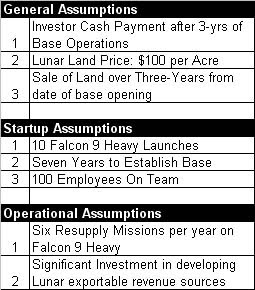
On the surface this seems like an odd question – can't one build a profitable lunar base for $40B, (assuming $100 per acre)?  Surely $40B is more than adequate not only to recoup investment costs, but to generate an enormous return to investors. But, remember one would have to maintain the base by providing regular transport to and from the moon indefinitely. How long could such a base operate on that one-time cash infusion of $40B before the base would have to start generating enough revenue to offset expenses? Since such regular transport to and from the moon will no doubt be expensive (even using innovative commercial solutions), I believe the revenue portion of the equation will have to be pretty high to offset both base and transport recurring costs.

Don’t hold me to the numbers below, they are for example purposes. You are welcome to build your Moon Base Spreadsheet here, but lets take a look what the numbers say.
 
First the Assumptions:


And now an initial set of detailed costs:


Now we bring these together in the Pro Formas:


Here are a few humble Observations:
  • Revenue from land recognitions provides incentive to START a base
  • Significant Revenues are needed to SUSTAIN a base. The land grants provide a base about a decade of operations to develop multiple $$ billions in annual revenue. As you saw from the pro formas, even a relatively inexpensive annual operating budget will be $5B per year (assuming six resupply missions per year). That is a lot of revenue to maintain a viable base. 
  • Adding a significant mid-term payout to investors could provide the liquidity the investors desire while still leaving enough capital for the long-term lunar export research and development. The pro formas assume a 200 multiple payout to lunar base investors after three years of operations. Assuming $7B in base startup costs, this would allow for a $14B payment to investors in the start of year four of base operations. Seven years of start-up plus three years of base operations means the investors' big (double your money) payout would come after year 10. 
  • Unless Government, Corporate, and Tourist Customers contribute significantly to base revenue, the base will need to develop significant exportable revenue sources (usual suspects like water mining, solar power farms, etc.) to become self-sustaining. 
  • Increasing the price per Acre paid for lunar real estate (above $100 per acre) is the greatest near-term strategy for increasing base profitability. $200 per acre instead of $100 means the land grants would be worth $80B. Signifcant time should be spent by consortiums on ways to maximize price per acre.
  • Launch pace will be a challenge - can the US handle a launch to a moon base every other Month (six resupply missions per year is my current assumption)?
  • Although not considered here, cis-lunar cyclers may make sense to assist in bi-monthly resupply missions.
  • I asked Alan Wasser what would happen to the land grants if a lunar base successfully opened, successfully sold land grants, and then some years later was to close. Using the railroad land grants of the 1800's as a model, Wasser expects the land grants to be revoked with the closure/abandonment of a lunar base. But to save their investment, he would expect others (potentially including current lunar land grant holders) to buy the struggling base for pennies on the dollar and keep the base operating.
  • The liability of operating the base "forever" is not reasonable nor will a corporation take on that risk without some way to mitigate the risk.
  • I envision a modification to the bill to include language such as “operate the base continually for XX years” as a way to bound corporate liability.
  • Similar to railroad land grants of the 1800’s, corruption and greed are powerful adversaries to good ideas (like transcontinental railroads). I believe this bill will need some language to prevent a lunar base consortium from engaging in the following trickery: Consortium builds a low cost base on the moon’s surface.  US courts recognize the land claims (on the assumption the base would be maintained).  Consortium sells land claims for $40B and distributes ALL the profits to its investors.  Consortium operates resupply missions for the amount of time it takes to sell the land claims (~1-3yrs).  Consortium immediately closes the base with the final sale of the land grants.  Consortium closes the legal entities they used to establish the base shielding its investors from liability.  Note: At this point, if the US courts wanted to revoke the consortium's land grants as a punitive action they could, but they would not be hurting the consortium since the consortium already sold their land claims for $40B. Only those who purchased the land grants would be hurt (disclosure: I am no lawyer, just surmising).
This exercise was very helpful to me. I often need to experiment with a spreadsheet to consider the implications of an idea. Feel free to modify these estimates – again the full spreadsheet is located here.  Can you operate a base for $5B per year? Won’t NASA pay close to $5B per year for access to a lunar base? Do you really need six resupply missions per year?  What if four resupply missions per year were adequate? How do lunar cyclers reduce base operations costs? What would revenue sources like television and marketing rights be worth? What "exportable" revenue sources offer the greatest potential of near-term profits?  All fun elements to go consider.

The big takeaways for me are:

  1. We all need to look for innovative ways to open the space frontier. Lunar land claim recognition is a huge innovative idea!
  2. Leveraging lessons learned from the US land grants used in the cross-continental railroad, we need to anticipate greed and abuse and write legislation that anticipates and penalizes such behavior.
  3. I would be delighted to support such legislation if it were to make it Congress. My congressmen love getting phone calls from me already!

Sunday, May 9, 2010

Space Property Rights: an Interview with Alan Wasser

Below is my interview with Alan Wasser, one of the premier legal authorities on Space Property Rights. Alan has always explained complicated legal concepts in a way my business mind could understand.  Alan believes the scale of current space investment is too small. Alan's plan for "land claims recognition" legislation holds the potential to dramatically increase the size and scale of investment in space, but is such a concept politically possible?  Read on for the details…


Question: How do you think space activists should react to the Obama administration's new space policy?

Alan: I'm just hoping that, now that the President has made it official, the space activist community will finally face up to the truth. On April 15th, at the Kennedy Space Center, The President said:
"Now, I understand that some believe that we should attempt a return to the surface of the Moon first, as previously planned. But I just have to say pretty bluntly here: We've been there before. Buzz has been there."
That makes it official that, as some of us predicted long ago, the Government is NOT going to pay for a Lunar Settlement. In fact, the Government isn't even going to pay for another flags and footsteps mission to the Moon.

Maybe, someday, a flags and footsteps mission to Mars, - maybe - someday, - but the taxpayers are certainly not going to let the government pay for a settlement there either.  So, if you believe, as I do, that the settlement of space is vital for the human species, you've got an unpleasant choice to make:

Option 1: You can stay in a state of denial - insisting that, someday, somehow, Apollo will return, or a pure philanthropist godmother will magically give space to you -

or

Option 2: You can face the fact that the only way to make the settlement of space happen is to get the for-profit entrepreneurs interested.  Profit. The profit motivation. Capitalism. The love of money is the root of all evil. Racing to open the frontier so the winner can get even more filthy rich.

Ugh!  Disgusting. What will people think of us for suggesting such a thing?  We could only consider that as the absolute last resort.

Yup! That's what we're down to. A lot of space activists will cling to Option 1 at first, but eventually many will accept that "for profit" really is the only way the human habitat can be expanded out beyond the Earth. We're down to our absolute last choice - or nothing.  If Obama could have funded Constellation, he would have. The President's choice to speak on April 15th, income tax day, tells you why he couldn't.

National prestige once required the US to have the world's tallest building. But, eventually the public stopped measuring national prestige the old way. Government space programs, like the world's tallest buildings, have become prestige items for second and third rate powers. Apollo turns out to have been a one-shot event, specific to its era, not the template for space development. Ever since, space supporters have been trying - and failing - over and over again, to convince US taxpayers they need a robust national government space program for spin-offs, incentives for engineering education, jobs, NEO warnings, etc. etc. etc.

Instead, the voters chose more tax cuts!

So it is up to free enterprise to open the space frontier, but that can happen only when there's a potential profit from it large enough to justify the huge risks and long lead time the project requires.


Question: Are there near-term profit motives large enough to incentivize such a push into space?

Alan: The best possibility is the idea of "land claims recognition", harnessing the huge potential value of Lunar and Martian land. It’s the only thing on the Moon that is valuable enough, and the hunt for new lands has always been the driver for human exploration and settlement.

Land claims recognition legislation would commit the Earth’s nations, in advance, to allowing a true private Lunar settlement to claim and sell (to people back on Earth) a reasonable amount of Lunar real estate in the area around the base, thus giving the founders of the Moon colony a way to earn back the investment they made to establish it.

For the details of such a proposal, and its legal basis under international law, see "Space Settlements, Property Rights, and International Law: Could a Lunar Settlement Claim The Lunar Real Estate It Needs To Survive?" which was published in SMU Law School's Journal of Air Law & Commerce, the leading law journal in its field.  Or, for a less legalistic description, with the answers to frequently asked questions, try this one.

As it enacts the new approach to space development, Congress should give private entrepreneurs the hope of profit they need by passing Land Claims Recognition legislation to facilitate the transition to entrepreneurial space development (Colin's Note: see a link to draft Land Claims Recognition legislation at the end of this interview).  If enacted, such legislation would spark a new, privately-funded commercial space race to settle the Moon and Mars, making the new order of space development even more beneficial for mankind than the last one.


Question: But the Obama plan is already supporting commercial space development. Isn't that enough?

Alan: Yes, but no. The problem is that their source of funds is still, ultimately, the US taxpayer.

In effect, we're just changing the kind of government contracts from "cost plus" to "fixed price". Probably a good thing, but nowhere near enough, because ultimately the same anti-tax forces will make sure that pool of money - "their" money - stays too small to fund a government space settlement.  We need a space industry that pays taxes, instead of one that depends on them.

Sending astronauts to the Space Station will be the first revenue stream for private space development. The second revenue stream will be space tourists, starting with the very rich, of course, but expanding as soon as possible to an ever widening segment of the public.

Unfortunately, however, those and all other currently identified revenue streams added together aren't enough to attract real venture capitalists, only enough to attract rich philanthropists. So it's important to look for new, novel profit potentials, like Land Claims Recognition.

Speaking of rich philanthropists, they can unfortunately provide some space activists a way to pretend they support "commercial space" without the unpleasant necessity of dealing with real commerce's need for true profit. They see Elon Musk's motives in SpaceX as "pure", so those squeamish space activists can ignore the fact that Elon made the tons of money he's spending on space from real commerce - selling an intangible service for a gigantic profit.

A true commercial business can raise vastly more investment capital than a charity. SpaceX has hundreds of millions, space settlement will take billions or tens of billions. We can't keep ducking the need for a real big PayPal-style profit potential, commercially generated, not taxpayer financed.


Question: Is the idea of celestial land claim recognition gaining momentum?

Alan: Definitely! One of the best examples is Eric Rice, CEO of Orbitec, a true commercial space company, who realized how logical this idea was several years ago and has done a great job of promoting it ever since. Earlier this year, he got a generous NASA Steckler grant to study the idea. Rice also served as a past President of the American Institute of Aeronautics and Astronautics (AIAA) Space Colonization Technical Committee, and he led six AIAA SCTC members on a Congressional lobbying effort in March 2010 that's led to a web discussion forum on the subject that includes a dozen key legislative space aides already.

He’s even posted a very slightly different version of my proposed draft law here.
He’s asking for feedback, and you can leave comments on the draft bill here.


Question: With Congressional staffers already reviewing and commenting on this draft bill, what are the next steps to get a revised bill to the US Congress?

Alan: Well, we still have a long way to go. The biggest step is to get one or more Congressmen and Senators to sponsor the bill. No one has gone that far, yet. It would also help a lot if more space activists took up the cause and started asking their own representatives about it.


Colin:  Thank you Alan!  I appreciate your efforts to expand humanity out into space.  I encourage my readers to review the draft land claims recognition bill.  Now is the time to make recommendations for needed changes to the bill.  The debate will be helpful to refine the bill.